Key Takeaways
-
Physical AI and embodied AI describe overlapping but distinct ideas: one is an industry term, the other comes from cognitive science and academic research.
-
Most companies use "Physical AI" in job postings and product announcements; "embodied AI" appears more often in research papers and academic contexts;
-
Knowing which term to use, and when, can affect how your resume is read by both applicant tracking systems and human recruiters.
-
Both terms point toward the same career opportunities in robotics, autonomous systems, and intelligent machines.
If you are looking into careers in robotics or autonomous systems, you'll likely see the terms 'Physical AI' and 'Embodied AI.' These terms often appear together in articles, sometimes even in the same sentence, and people often assume they mean the same thing.
Although there may not be a myriad of differences, the distinction between the two terms is important for your professional documents and presentation (e.g. CV, job title, and interpretation of work experience during an interview). The purpose of this article is to clearly define the terms, outline their etymological origins, examine their differences, and provide job-seeking and hiring position-related tactics.
Quick Answer: Physical AI vs Embodied AI
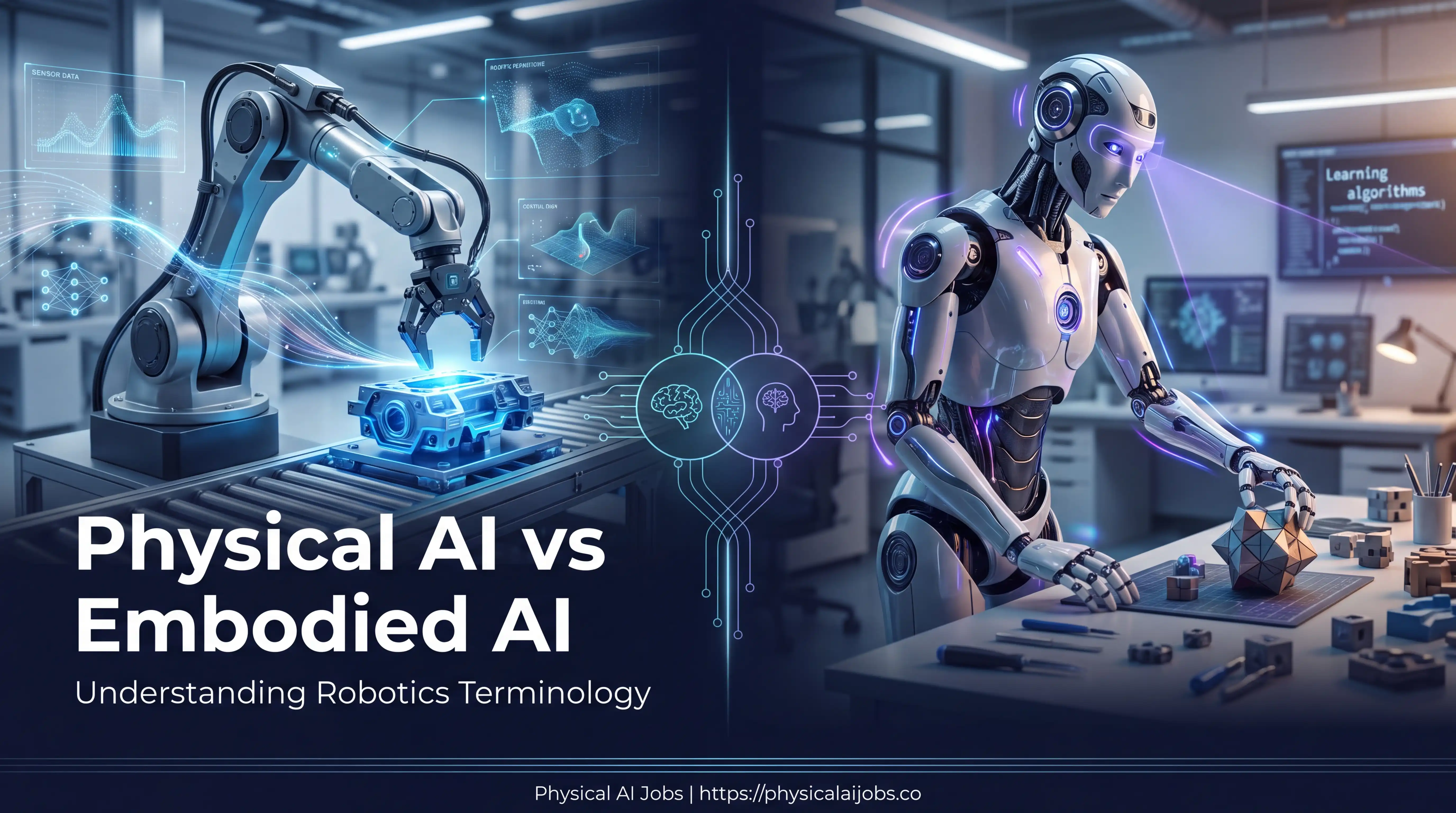
If you need the short version before diving into the detail: The term Physical AI encompasses the greatest scope. It is the umbrella industry term. It describes any systems that act and perceive in the physical world. This includes robots, self-driving cars, autonomous drones, and even autonomous surgical systems.
Embodied AI is the more specific and constricted term. It has a background in cognitive science. It tells the phenomenon in which the presence of a 'body' is fundamental to the existence of 'intelligence', and intelligence is developed through interaction with the surrounding environment.
Every system that is classified as Embodied AI is classified as Physical AI. However, the converse is not true. In the employment domain, Physical AI is the term you are more likely to encounter in job advertisements. "Embodied AI" is more common in research papers, academic job listings, and companies with strong ties to university research labs.
What Is Physical AI?
Physical AI refers to AI systems that interact with and make decisions in the real world. Once the system can receive sensory data (could be through visual input or physically receiving data, etc.), process that data with machine learning (or some other variation of AI), and perform a task that affects the environment around it, then it falls under the umbrella of Physical AI.
There is a common misconception that Physical AI is a single technology. It is not. Physical AI has many facets. Systems that interact directly with the real world are especially good examples. Some examples include package sorting warehouse robots, autonomous trucks, or robotic arms that assist with the assembly of electronics.
One of the leading examples of the use of Physical AI is NVIDIA. With their robotics and autonomous systems platform, they organize and classify their work under the Physical AI label. But now, it has a more general use across the board. From established automotive companies to robotics startups, Physical AI is a common term in job postings.
Key properties of Physical AI systems:
-
They have a physical form that interacts with objects and environments.
-
They must operate in real time, often with latency requirements measured in milliseconds .
-
Their errors can have physical consequences, which makes safety a core engineering concern.
-
They are trained using a combination of real-world data and simulation, because collecting physical interaction data at scale is expensive and slow.
For a deeper technical breakdown of how Physical AI works, see our guide on what Physical AI is and how it works.
What Is Embodied AI?
Embodied AI is a concept with roots in cognitive science, philosophy of mind, and academic robotics research. It draws on the theory of embodied cognition, which holds that intelligence does not exist independently of a body. Intelligence, in this view, is not a disembodied computation that happens to be connected to hardware. It emerges from the ongoing interaction between an agent, its body, and its environment.
There are significant potential consequences for AI of this research. It is becoming clearer that intelligence requires an embodiment. Traditionally, the assumption has been that you can teach systems to be intelligent or learn how to solve problems through language or image training. But systems require a degree of presence in the world to do this.
As your Physical AI systems interact with the world, they will inevitably learn and grow to be more resilient. Having the ability to learn through physical interaction is (from the Physical AI perspective) one critical building block to realize true intelligence.
Embodied AI research focuses on questions like:
-
How does a robot learn to manipulate objects it has never seen before?
-
How does a system develop spatial reasoning through movement rather than through labeled training data?
-
Can a robot generalize skills learned in one environment to a completely new environment without retraining?
Research in this area is published extensively through institutions like the Stanford Artificial Intelligence Laboratory (dofollow), where work on robot learning and physical interaction has shaped much of the current thinking about how embodied systems should be trained. The ACM Digital Library's robotics and AI section (dofollow) contains a large body of peer-reviewed research on embodied learning if you want to go deeper into the academic literature.
What Are the Key Differences Between Physical AI and Embodied AI?
The cleanest way to see the difference is to look at where each term comes from and what work it is doing.
| Dimension | Physical AI | Embodied AI |
|---|---|---|
| Origin | Industry and engineering | Cognitive science and academic research |
| Primary context | Job postings, product roadmaps, company language | Research papers, university labs, academic conferences |
| Scope | Broad: any AI system acting in the physical world | Narrower: systems where learning through physical interaction is central |
| Core claim | AI can operate effectively in real-world environments | Intelligence fundamentally requires physical interaction to develop |
| Example systems | Autonomous vehicles, warehouse robots, surgical robots | Research robots learning manipulation, locomotion, open-ended exploration |
| Who uses it | NVIDIA, Boston Dynamics, automotive companies, startups | DeepMind, academic robotics labs, research-oriented companies |
The critical point is scope. Physical AI covers a lot of ground. For example, a robotic arm that uses a perception model to identify and grasp objects is Physical AI. Determining if it is also embodied AI is a more complicated matter. It depends on the model training and whether there was an iterative focus on physical interaction in the learning process.
Sometimes, a model which is completely trained through a simulated environment, and which is later deployed on real hardware, is referred to as Physical AI Technology. It can also be called embodied AI, but typically the learning process did not include a real physical experience.
On the other hand, a model that falls, learns, and improves itself through physical interaction would be more of an example of the definition of embodied AI.
When we scan job listings across Physical AI companies, the term 'Physical AI' appears in roughly 4 times as many job titles and company descriptions as 'embodied AI.' However, roles at companies with deep research ties, particularly those spinning out of university labs or operating dedicated research divisions, use 'embodied AI' far more frequently; Knowing this helps job seekers target their language to the right audience. - Physical AI Jobs
How Is the Terminology Used Across the Industry?
The practical reality is that these terms are used inconsistently, and the inconsistency is not random. It follows predictable patterns based on company type, funding stage, and research orientation.
Large platform companies such as NVIDIA and major automotive manufacturers overwhelmingly use "Physical AI." It is clear, accessible to a broad audience, and connects naturally to hardware products and deployment use cases.
Early-stage robotics startups tend to use "Physical AI" in external communications and fundraising materials, because it is more legible to non-specialist investors and customers. Internally, their engineers may use both terms depending on context.
Research-oriented companies and university spinouts use "embodied AI" more frequently. Companies like DeepMind, companies with active connections to academic labs, and organizations working on fundamental problems in robot learning tend to use "embodied AI" both internally and in job postings.
Academic institutions almost exclusively use "embodied AI" in their publications and lab descriptions. If you are applying for a research role at a university robotics lab, using "embodied AI" correctly and fluently signals that you understand the intellectual context of the work.
Job board data from our platform reflects this pattern clearly. Searching for "Physical AI engineer" returns a significantly larger set of results than searching for "embodied AI engineer," particularly outside of the United States. In markets like Germany, Japan, and South Korea, "Physical AI" dominates even more strongly, because the term maps cleanly onto industrial automation and manufacturing robotics contexts. Browse active listings in Physical AI roles in Germany, Physical AI roles in Japan, and Physical AI roles in South Korea to see this pattern in the actual job market.
Coverage from Robotics Business Review and LinkedIn's Economic Graph both confirm that "Physical AI" has seen sharply growing usage in professional contexts over the past two years, while "embodied AI" has remained more stable and academically concentrated.
What Job Titles Use Physical AI vs Embodied AI?
Job titles themselves rarely include either full phrase. Instead, the terminology shows up in job descriptions, required skills sections, and company mission statements. That said, there are patterns worth knowing.
Titles more associated with Physical AI contexts:
-
Robotics Software Engineer
-
Autonomy Engineer
-
Perception Engineer
-
Controls Engineer
-
Physical AI Research Scientist
-
Robot Learning Engineer
Titles more associated with embodied AI contexts:
-
Embodied AI Researcher
-
Robot Learning Scientist
-
Embodied Intelligence Engineer
-
Research Scientist, Robot Perception
-
Foundation Model Engineer (Robotics)
The overlap is significant. If you were to try to hire a "Robot Learning Engineer" at Figure or 1X, you would be describing the same work for both Physical AI and embodied AI, depending on the lens you decide to use. Externally, the company will use "Physical AI" in their job description while talking about the actual research as "embodied AI".
Browse our full listing of open embodied AI jobs and Physical AI engineering roles to see how specific companies currently label these positions.
Our review of over 2,000 robotics and Physical AI job postings found that companies explicitly mentioning 'embodied AI' in their descriptions were 60% more likely to require a graduate degree & 45% more likely to list research publication experience as a preferred qualification. This reflects the continued association of embodied AI with research-heavy roles, even as the applied engineering market for Physical AI grows much faster. - Physical AI Jobs
Resume and Career Guidance: Which Term Should You Use?
The answer depends on who is reading your resume and what role you are targeting.
If you are applying to product-focused or engineering-heavy roles at robotics companies, startups, or large technology firms: use "Physical AI." It is the term these employers are most likely to be searching for in applicant tracking systems. It is also the term that will resonate with non-technical stakeholders who may review your application.
If you are applying to research roles, university positions, or companies with strong academic ties: use "embodied AI" where it is accurate to your experience. Using the right academic vocabulary signals that you understand the intellectual tradition you are entering.
If you have experience in both contexts: use both terms strategically. A summary statement might reference your background in "Physical AI systems and embodied robot learning." This covers both semantic clusters without overloading your resume with jargon.
A few practical rules:
-
Mirror the language in the job posting. If the posting uses "Physical AI," use it. If it uses "embodied AI," use it. Applicant tracking systems are keyword-sensitive.
-
Do not use "embodied AI" if your experience is primarily in deployment, controls, or systems integration. The term carries an implication of research-oriented learning work.
-
For interview preparation, be ready to explain both terms and the relationship between them. Interviewers at research-adjacent companies will often probe your understanding of the conceptual distinctions. Our guide on common robotics interview questions covers how to handle terminology and conceptual questions under pressure.
For engineers building their first robotics-focused resume, our guide on how to build a robotics portfolio walks through how to frame your projects and skills in the language that employers are currently using.
Market data from Statista's robotics market research and industry analysis from Open Robotics both point to sustained growth across both the research and applied sides of the field, which means demand for engineers fluent in either context is likely to remain strong.
What Are the Industry Trends Shaping Both Terms?
The distinction between Physical AI and embodied AI is narrowing in practice, even if it persists in language. Two developments are driving this convergence.
First, foundation models are moving into robotics. Models that can perform at a level comparable with the most advanced ideas of language and vision are now also able to perform physical actions. This is due to very large models, which contain broad knowledge coming from the fields of language and vision and are constructed using the same underlying modular frameworks, being adapted to perform physical actions. As a consequence, the "software AI" and "physical AI" designations can no longer be clearly separated, as they have in the past.
Second, sim-to-real transfer is improving rapidly. As simulation environments become more physically accurate and as techniques for bridging the sim-to-real gap mature, more embodied AI research is moving from purely physical training to simulation-based training. This reduces one of the key distinctions between embodied AI (learned through physical experience) and Physical AI (any system operating in the real world).
The result is a field where the terminology is in flux. Engineers and researchers who can move fluently between both contexts - who understand the engineering demands of deployed Physical AI systems and the research framing of embodied AI - are increasingly valuable. This is one reason why roles combining ML research skills with robotics deployment experience command premium compensation. See our full breakdown of the highest-paying robotics and Physical AI careers for current salary data by role.
Frequently Asked Questions
Are Physical AI and embodied AI the same thing?
They overlap but are not identical. Embodied AI focuses on intelligence developed through physical interaction, while Physical AI is the broader term for AI systems operating in the real world. All embodied AI can be considered Physical AI, but not all Physical AI fits the research definition of embodied AI.
What is the difference between Physical AI and embodied AI?
The main difference is scope. Embodied AI comes from cognitive science and emphasizes the role of a body in developing intelligence. Physical AI is an engineering term for AI systems that sense, decide, and act in physical environments.
Which term do companies use more, Physical AI or embodied?
"Physical AI" is more common in commercial and product contexts. Based on our analysis of job postings, it appears roughly four times more frequently than "embodied AI" in job titles and company descriptions. "Embodied AI" is more common in academic and research settings.
Should I use Physical AI or embodied AI on my resume?
Use the terminology from the job posting. For most robotics engineering and product roles, "Physical AI" is appropriate. For research roles, "embodied AI" may be more relevant. Using both is fine when they accurately describe your experience.
What job titles use Physical AI vs embodied AI?
"Physical AI" appears in titles such as Robotics Software Engineer, Autonomy Engineer, and Physical AI Research Scientist. "Embodied AI" is more common in titles such as Embodied AI Researcher, Robot Learning Scientist, and Embodied Intelligence Engineer.
Is one term more popular in the industry?
"Physical AI" is more popular in commercial and product-focused roles. Its use has grown significantly since 2023, while "embodied AI" remains more common in academic and research environments.
Remember:
The terminology debate between Physical AI and embodied AI is ultimately less important than building the skills that both terms point toward: the ability to design, build, and deploy intelligent systems that work reliably in the real world.
Start by exploring the full range of Physical AI and embodied AI jobs currently available, or read our practical guide on how to start a career in robotics for a step-by-step path into the field.
About the Author
Physical AI Jobs Board is passionate about the future of physical AI and robotics careers. Our goal is to help job seekers, engineers, and researchers navigate this fast-growing industry by providing in-depth guides, company insights, and the best career opportunities in the world of embodied intelligence.