Key Takeaways
-
The 15 highest-paying robotics roles in this guide range from $90k at entry level to more than $300k in total pay at the top of the field.
-
Robot Learning Engineer is the single highest-paying robotics job right now, driven by a genuine shortage of engineers who can combine machine learning with real hardware deployment;
-
You do not need a PhD to earn six figures in robotics. Strong engineers with the right skills and a solid portfolio consistently land high-paying roles without a graduate degree.
-
Equity at venture-backed robotics startups can make total compensation significantly higher than base salary alone - sometimes two to three times higher for early hires.
Robotics careers are lucrative. But not all robotics careers earn equally. The difference in income potential between a lowest-earning and a highest-earning professional in robotics is higher than you would probably think. Robotics technicians and robot learning engineers are both in the field of robotics. The former earns $55k per year. The latter, $250k per year or even higher.
What makes such a difference? Mostly three factors: the scarcity of your skills, the difficulty of recruiting for the position, and the impact that your work makes on revenue or risk for the business. Positions listed in the guide belong to the highest-paid ones. For each one, we are going to discuss what the position actually is (without technicalities), what it earns, why it earns such an amount of money, and what it takes to get there.
The salary numbers used in this guide are derived from the analysis of thousands of robotics job postings and disclosed salaries in the United States only. International salaries are mentioned where the patterns are different.
Highest Paying Robotics Jobs Ranked
Here are 15 of the highest-paying robotics jobs, from highest to lowest average total compensation at the mid-to-senior level:
-
Robot Learning Engineer
-
Perception and Autonomy Engineer
-
Robotics Research Scientist
-
Robotics Software Engineer (Staff / Principal)
-
SLAM Engineer
-
Motion Planning Engineer
-
Computer Vision Engineer
-
Controls Engineer
-
Simulation Engineer
-
Embedded Systems Engineer
-
Mechatronics Engineer
-
Robotics Systems Architect
-
Field Deployment Engineer (Senior)
-
Robotics Product Manager (Technical)
-
Robotics QA / Safety Engineer (Senior)
Each role is covered in detail below, with salary ranges, a plain-English explanation of the work, and what drives the pay.
1- Robot Learning Engineer
What it is: A Robot Learning Engineer teaches robots new skills using machine learning. Think of it like training a dog, but instead of treats, you use data. The engineer designs the training process, runs experiments in a virtual environment (called a simulator), and then tests whether the robot can do the same thing in the real world. When it works, the robot can do tasks it was never directly programmed for.
This is genuinely hard. Getting a machine to learn a skill in a computer and then perform it reliably on real hardware is one of the trickiest problems in the field. That difficulty is why this role pays the most.
What it pays:
-
Entry level: $120k to $150k
-
Mid level: $160k to $220k
-
Senior level: $230k to $300k+
-
Total comp (with equity at funded startups): can exceed $400k at well-funded humanoid robot companies
Why it pays so much: The skills required, deep reinforcement learning combined with real robotics hardware knowledge, are genuinely rare. Most ML engineers do not know robotics. Most robotics engineers do not know ML at this depth. The people who know both are in very high demand and very short supply.
What you need: Python, PyTorch, experience with simulation environments like Isaac Sim or MuJoCo, and hands-on experience getting a trained policy to run on real hardware. A strong portfolio of robot learning experiments matters more than a degree.
Browse open robot learning and Physical AI jobs on our platform.
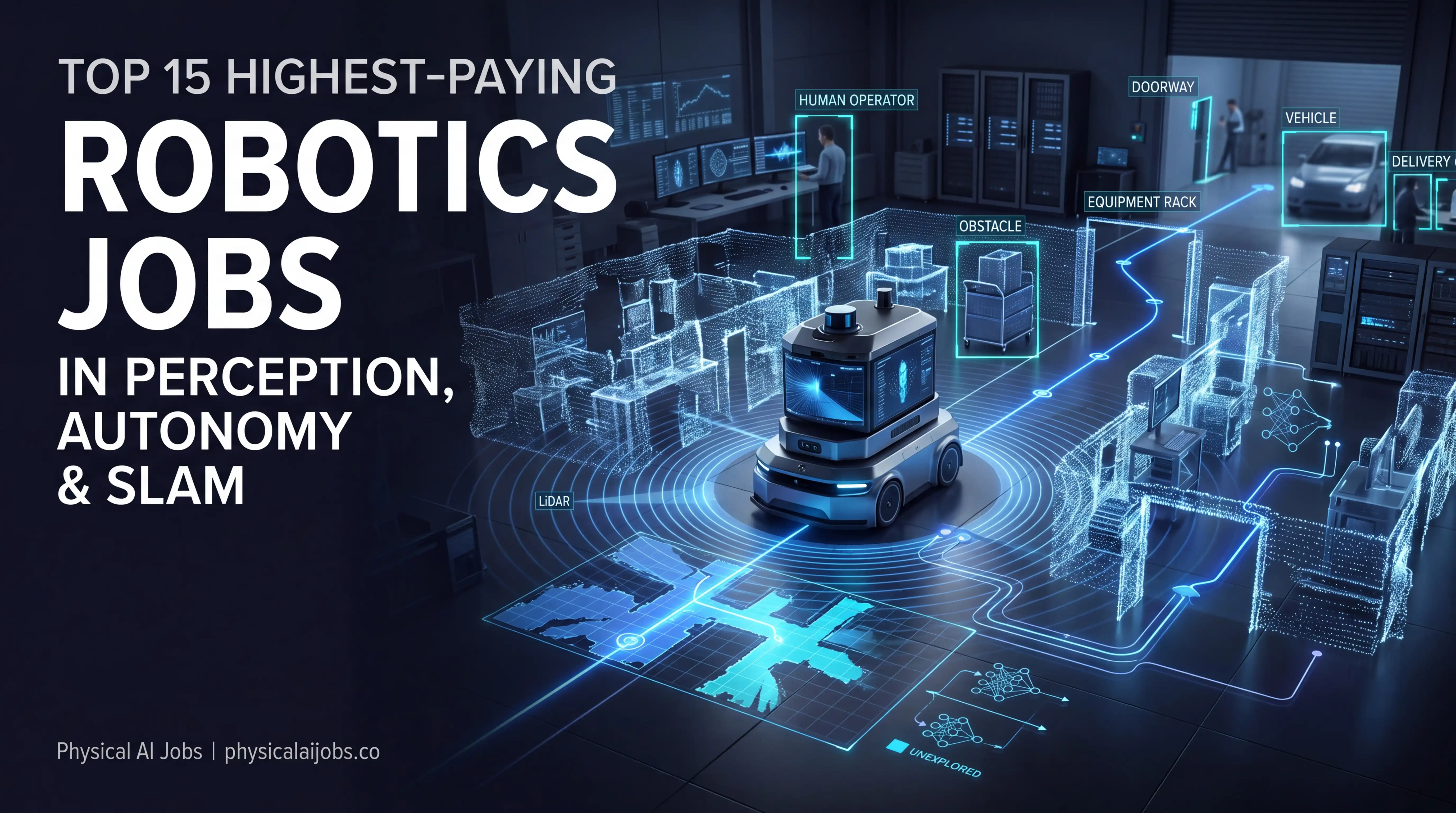
2- Perception and Autonomy Engineer
What it is: A Perception Engineer helps a robot understand what is around it. Cameras, lasers, and other sensors collect raw data. The perception engineer builds the software that turns that raw data into useful information: "there is a box here," "that person is walking toward me," "the floor ends three meters ahead."
An Autonomy Engineer takes that information and decides what to do with it. "The box is here and I need to pick it up. Here is my plan." Together, perception and autonomy are the eyes and brain of a robot.
What it pays:
-
Entry level: $100k to $130k
-
Mid level: $150k to $200k
-
Senior level: $200k to $270k
Why it pays so much: Autonomous vehicles, drones, and humanoid robots all depend entirely on perception working correctly. A bug in the perception system is not just inconvenient. It can be dangerous. That responsibility commands premium pay.
What you need: Deep learning, computer vision (detecting and tracking objects in images and video), sensor fusion (combining data from cameras and lasers for a more accurate picture), Python, C++, and ROS 2. Experience with real sensor hardware is a significant advantage over purely research-based backgrounds.
3- Robotics Research Scientist
What it is: The role of a Research Scientist in robotics consists of working on unsolved problems in robotics. A Research Scientist in robotics designs experiments, implements ideas, writes reports, and publishes papers that later become bases for engineers who actually create a product out of these papers. This job is the most scientific one on the list, but many research scientists work in companies, not just universities.
What it pays:
-
Entry level (often requires a PhD): $130k to $160k
-
Mid level: $170k to $230k
-
Senior level: $240k to $320k+
Why it pays so much: Companies like Waymo, DeepMind, and Physical Intelligence compete fiercely for top researchers; The best researchers move an entire product category forward. That leverage makes them very expensive to hire and very expensive to lose.
What you need: Typically a Master's or PhD in robotics, machine learning, or a related field. A publication record at top conferences (ICRA, CoRL, NeurIPS) is often expected. Strong Python and deep learning skills are baseline.
4- Robotics Software Engineer (Staff and Principal Level)
What it is: The position of a senior or principal Robotics Software Engineer is not just coding. The person in this position is responsible for designing the architecture, which other engineers will be building on. These people make decisions regarding the architecture of the entire robot software stack, the tools for development, and scaling within the company. This position is half engineering and half management.
What it pays:
-
Staff level: $180k to $240k
-
Principal level: $230k to $300k+
-
Distinguished / Fellow: rare, but can exceed $400k at large companies
Why it pays so much: Seniority is earned over many years of work. These engineers have seen what goes wrong at scale and how to avoid it. That experience is extremely hard to hire for and companies pay accordingly.
What you need: Eight to fifteen years of relevant experience, a track record of leading technical projects end-to-end, deep knowledge of at least two or three major areas of the robotics stack (perception, planning, controls, or infrastructure), and the ability to mentor other engineers effectively.
5- SLAM Engineer
What it is: SLAM stands for Simultaneous Localization and Mapping. It is a fancy term for something extremely simple -- the robot has to both locate itself and create a map of its environment. The easiest way to understand this is to imagine yourself waking up in an unfamiliar building at night without your phone. While exploring the building, you simultaneously construct a mental map and know where you are located. SLAM engineers create
What it pays:
-
Entry level: $100k to $125k
-
Mid level: $140k to $185k
-
Senior level: $190k to $250k
Why it pays so much: SLAM is mathematically deep. It requires solid knowledge of probability, geometry, and optimization. Most software engineers cannot do it. Even among robotics engineers, SLAM specialists are a small group. Scarcity drives the price up.
What you need: Strong mathematics (linear algebra, probability, optimization), C++ for performance-critical code, experience with SLAM frameworks like GTSAM or g2o, and hands-on experience with lidar or camera-based odometry systems.
See current SLAM engineer jobs on our platform.
SLAM engineers are among the hardest roles to fill across the entire Physical AI hiring market; Based on our analysis, open SLAM positions stay unfilled for an average of 60 to 90 days longer than equivalent-level robotics software engineering roles. Companies routinely offer signing bonuses and above-band compensation to close candidates with proven SLAM experience. - Physical AI Jobs
6- Motion Planning Engineer
What it is: The motion planning engineer determines the movement trajectory of the robot. This is not "move from point A to point B," but rather "move from point A to point B safely, without colliding with any object, with maximum efficiency, and taking into account all possible unexpected movements." For a robot arm, this is the programming of the trajectory of each joint. For an autonomous car -- the planning of a dynamic movement trajectory in traffic.
What it pays:
-
Entry level: $100k to $125k
-
Mid level: $135k to $180k
-
Senior level: $185k to $245k
Why it pays so much: Motion planning problems are hard mathematically and demanding computationally. Solving them fast enough to be useful in the real world requires both theoretical depth and strong engineering skill.
What you need: Optimization algorithms, sampling-based planning (techniques like RRT and PRM, which are ways of exploring possible robot paths efficiently), C++ for real-time code, and familiarity with the MoveIt framework for robot arms or equivalent planning stacks for mobile robots.
See open motion planning engineer jobs on our platform.
7- Computer Vision Engineer
What it is: The computer vision engineer develops algorithms that teach the computer to understand visual information from photographs and video streams. Robotics requires creating the systems that will allow robots to identify and classify the objects depicted in images, track their movement and distance, etc. This profession is similar to perception engineering; however, this one is more concentrated on developing algorithms based on the data obtained by the camera.
What it pays:
-
Entry level: $95k to $120k
-
Mid level: $130k to $175k
-
Senior level: $180k to $240k
Why it pays so much: Computer vision is at the core of almost every Physical AI system. Cameras are cheap and widely available; which means vision-based systems are often preferred over more expensive sensor setups. Engineers who can build reliable vision systems for real-world conditions (bad lighting, motion blur, unusual objects) are consistently in demand.
What you need: Deep learning for images (CNNs, detection architectures like YOLO and DETR), OpenCV, PyTorch, camera calibration, and experience deploying vision models on real hardware rather than just running them on benchmark datasets.
8- Controls Engineer
What it is: The controls engineer is responsible for controlling the robot's movement trajectory. Once the robot arm gets an order to move to some particular point, it is the engineer's algorithm that implements it by constantly correcting the power delivered to motors to achieve the accuracy of movement. It ensures the correct movement of the robot without shaking.
What it pays:
-
Entry level: $90k to $115k
-
Mid level: $125k to $170k
-
Senior level: $175k to $235k
Why it pays so much: Control systems engineering is a discipline with a long history and deep mathematics; Good controls engineers are trained over years, not months. The hardware consequences of bad control code (damaged equipment, failed deployments, safety incidents) make experienced controls engineers highly valued.
What you need: Control theory (PID control, state space methods, model predictive control), mathematics, C++ for real-time systems, experience with robot hardware platforms, and ideally ROS 2 control frameworks.
Research published through the TU Delft Robotics Institute, one of Europe's leading robotics research centers, consistently highlights the growing overlap between classical control theory and modern machine learning methods in deployed robot systems, which is driving demand for controls engineers who can work across both approaches.
9- Simulation Engineer
What it is: A Simulation Engineer creates the simulated environments in which the robot is trained prior to going out into the real world. This can be viewed as the equivalent of a flight simulator for pilots -- but for robots. The simulation environment should be so realistically created that everything the robot learns there will be applicable after moving to the real world. It is not an easy task.
What it pays:
-
Entry level: $85k to $110k
-
Mid level: $120k to $165k
-
Senior level: $165k to $220k
Why it pays so much: Simulation has become central to how Physical AI companies train their robots; As robot learning has grown, so has demand for engineers who can build high-quality simulation environments. The role has seen faster pay growth than almost any other in robotics over the past three years.
What you need: Experience with at least one simulation platform (Isaac Sim, Gazebo, MuJoCo, or Webots), Python and C++, 3D asset and scene building skills, and understanding of domain randomization techniques (deliberately varying conditions in simulation to make trained robots more robust in the real world).
See open simulation engineer positions on our platform.
10- Embedded Systems Engineer
What it is: An Embedded Systems Engineer develops the code, which is executed by the computer located inside a robot. Unlike ordinary code that is executed on a personal computer or server, embedded code is run on a very resource-constrained microprocessor with a limited amount of memory and computational power. It is responsible for controlling motors, reading sensor data, and communication between the robot's modules.
What it pays:
-
Entry level: $85k to $108k
-
Mid level: $115k to $155k
-
Senior level: $160k to $215k
Why it pays so much: Embedded engineers are hard to train quickly; The skill set crosses both software and hardware in ways that most engineers specialize in one or the other. Senior embedded engineers with robotics experience are genuinely scarce.
What you need: C and C++ for embedded systems, real-time operating systems (RTOS), hardware communication protocols (CAN bus, SPI, I2C), hardware debugging tools, and experience with the specific processor families used in robotics (typically ARM-based).
11- Mechatronics Engineer
What it is: The term mechatronics stands for combining mechanical engineering, electronics, and software. A Mechatronics Engineer designs and implements systems in which all three mentioned components interact with each other. In robotics, this usually includes the design of the physical structure of the robot, its motors and electronics, and programming of the software making it move.
What it pays:
-
Entry level: $80k to $105k
-
Mid level: $115k to $155k
-
Senior level: $160k to $210k
Why it pays so much: Genuine mechatronics depth is rare. Most engineers specialize in one of the three disciplines; Engineers who can reason fluently across mechanical, electrical, and software concerns are extremely useful at hardware-heavy robotics companies.
What you need: Mechanical design skills (CAD tools like SolidWorks or Fusion 360), electronics basics (circuit design, motor selection, power systems), and software skills (C++, Python, embedded programming). A formal mechatronics degree or equivalent breadth of practical experience is typically expected.
12- Robotics Systems Architect
What it is: The System Architect is responsible for planning the overall architecture of the complex robot system. The System Architect figures out how various components interact in the system - which software interacts with which hardware, the flow of data within the system, and handling of errors in the process. The Architect does not have to write code - they create the blueprint, and other people implement it.
What it pays:
-
Mid level: $150k to $195k
-
Senior level: $200k to $270k+
Why it pays so much: Systems architecture requires broad experience across many areas of robotics; You need to have built a lot of things that worked, and a lot that failed, to make good architectural decisions. That depth of experience takes many years to accumulate.
What you need: Ten or more years of robotics engineering experience across multiple disciplines, strong communication skills to work with diverse engineering teams, and the ability to reason about trade-offs at a system level rather than optimizing individual components in isolation.
13- Senior Field Deployment Engineer
What it is: The Senior Field Deployment Engineer is responsible for taking robots that work in the laboratory environment and making them work in real-world conditions - at customers' locations, in the factory setting, in the warehouse, or wherever else the robot will be used. The Senior Field Deployment Engineer troubleshoots issues that arise in the real-world conditions, gathers feedback, and collaborates with the product and engineering teams to make the system better. Engineering and problem-solving go hand-in-hand in this role.
What it pays:
-
Mid level: $110k to $150k
-
Senior level: $155k to $200k
Why it pays so much: Deployment at scale is where robotics companies make their money. Engineers who can keep commercial deployments running and improve them over time are directly tied to revenue. Senior field engineers also carry significant responsibility for customer relationships.
What you need: Strong general robotics software skills, hardware troubleshooting ability, good communication skills, and comfort working in variable environments. ROS 2 is typically expected. Willingness to travel is a practical requirement for most roles.
14- Robotics Technical Product Manager
What it is: The Technical Product Manager (TPM) in Robotics is the person who defines the functionality of the robot and works with the engineers to deliver the product. The TPM translates customer needs and business objectives into engineering requirements and ensures that the team is delivering the product according to the timeline. A good
What it pays:
-
Mid level: $140k to $180k
-
Senior level: $185k to $250k+
Why it pays so much: Good technical product managers in robotics are extremely scarce; The role requires technical credibility (engineers need to respect your judgment) combined with business clarity (you need to understand what is worth building). Most people are strong at one or the other.
What you need: Several years of engineering experience in robotics or adjacent fields, strong written and verbal communication, comfort with ambiguity, and the ability to prioritize ruthlessly when engineering bandwidth is constrained.
15- Senior Robotics Safety and QA Engineer
What it is: A Senior Safety and QA Engineer makes sure robots do not do dangerous things. They design the test cases that catch bugs before deployment, set the safety standards the robot must meet, and work with regulatory bodies where required. In safety-critical applications like surgical robots, autonomous vehicles, and human-collaborative industrial robots, this role is both legally required and deeply consequential.
What it pays:
-
Mid level: $115k to $155k
-
Senior level: $160k to $215k
Why it pays so much: Safety-critical software is subject to much higher standards than standard software; Engineers with experience in functional safety frameworks (ISO 26262 for automotive, IEC 62061 for industrial robots) are rare and in high demand at companies deploying robots in regulated environments.
What you need: Deep testing and quality assurance skills, familiarity with robotics software stacks, and for senior roles, knowledge of functional safety standards relevant to your sector. Python for test automation and ROS 2 familiarity are baseline.
Across our platform data, the roles that command the highest compensation premiums relative to equivalent software engineering roles at the same companies are SLAM engineer, Robot Learning Engineer, and Robotics Systems Architect. In each case, the premium exists because the supply of qualified candidates is genuinely small relative to demand. - Robotica Network
| # | Role | Entry Level | Mid Level | Senior Level |
|---|---|---|---|---|
| 1 | Robot Learning Engineer | $120k – $150k | $160k – $220k | $230k – $300k+ |
| 2 | Perception and Autonomy Engineer | $100k – $130k | $150k – $200k | $200k – $270k |
| 3 | Robotics Research Scientist | $130k – $160k | $170k – $230k | $240k – $320k+ |
| 4 | Robotics Software Engineer (Staff / Principal) | — | $180k – $240k (Staff) | $230k – $300k+ (Principal) |
| 5 | SLAM Engineer | $100k – $125k | $140k – $185k | $190k – $250k |
| 6 | Motion Planning Engineer | $100k – $125k | $135k – $180k | $185k – $245k |
| 7 | Computer Vision Engineer | $95k – $120k | $130k – $175k | $180k – $240k |
| 8 | Controls Engineer | $90k – $115k | $125k – $170k | $175k – $235k |
| 9 | Simulation Engineer | $85k – $110k | $120k – $165k | $165k – $220k |
| 10 | Embedded Systems Engineer | $85k – $108k | $115k – $155k | $160k – $215k |
| 11 | Mechatronics Engineer | $80k – $105k | $115k – $155k | $160k – $210k |
| 12 | Robotics Systems Architect | — | $150k – $195k | $200k – $270k+ |
| 13 | Senior Field Deployment Engineer | — | $110k – $150k | $155k – $200k |
| 14 | Robotics Technical Product Manager | — | $140k – $180k | $185k – $250k+ |
| 15 | Senior Robotics Safety and QA Engineer | — | $115k – $155k | $160k – $215k |
What Skills Boost Your Robotics Salary the Most?
Not all skills are equally valuable in the world of robotics. This is our list of the most valuable skills for getting paid more, based on the data from compensation analysis of thousands of job offers:
Reinforcement learning for robotics. Most ML engineers know RL theory. Very few can apply it to real robot hardware. The ones who can command a significant premium. This skill alone can add $30k - $60k to a compensation package at the right company.
Real-time systems expertise. Writing code that has to run in milliseconds on hardware with limited resources is a specialized skill; Engineers who are comfortable in this environment are more valuable than those who are not, especially at companies deploying at scale.
Sensor fusion. Combining data from multiple sensors (cameras, lidar, IMUs) to get a better picture of the world than any single sensor provides is both technically demanding and practically essential. It appears as a premium skill in perception, SLAM, and autonomy job listings.
C++ proficiency at a high level. Basic C++ is common. C++ that is efficient, safe, and maintainable under the performance constraints of robotics is less common. Senior-level C++ skills consistently correlate with higher compensation.
Simulation platform experience. As sim-to-real pipelines have matured, experience with platforms like Isaac Sim and MuJoCo has shifted from a nice-to-have to a meaningful differentiator in hiring.
For structured skill development, Udacity's Robotics Software Engineer Nanodegree covers several of these areas in a project-based format. Current robotics salary benchmarks by role and skill are tracked on Levels.fyi, which aggregates self-reported compensation data across technology and engineering roles.
For a full breakdown of which skills map to which roles, see our guide on what skills you need for a robotics career.
Which Companies Pay Robotics Engineers the Most?
Pay in robotics correlates strongly with company type and funding stage. Here is how the market breaks down:
Well-funded humanoid robot startups (Figure AI, 1X, Physical Intelligence, Apptronik) currently pay the highest total compensation packages. This is driven by competitive talent markets and the need to attract engineers from AI & autonomous vehicle backgrounds. Base salaries are competitive, and early equity can add substantial value for engineers who join before Series B or C funding rounds.
Autonomous vehicle companies (Waymo, Aurora, Zoox) pay at or near the top of the market for most roles, particularly in perception, planning and autonomy. These are well-capitalized organizations with mature compensation frameworks.
Large technology companies with robotics divisions (Google/Intrinsic, Amazon Robotics, Microsoft) offer strong base salaries and comprehensive benefits. Total comp may be lower than top startups in base equity value but more predictable.
Industrial robotics companies (ABB, FANUC, KUKA) pay competitively within their sectors but generally below the top of the venture-backed market. The trade-off is stability, structured career progression, and international scope.
For the most current and role-specific salary data, Glassdoor's robotics engineer salary data aggregates self-reported figures across companies and experience levels. The International Federation of Robotics publishes annual reports on industry growth and workforce trends that provide broader market context.
A full company-by-company breakdown of who is hiring and at what scale is in our guide on robotics companies actively hiring right now.
You can also connect with employers and explore Physical AI career opportunities through Physical AI and robotics jobs on Robotica Network, which aggregates listings from companies across the global ecosystem including some that do not advertise widely through standard job boards.
How Do You Negotiate a Higher Robotics Salary?
Most of the engineers miss out on the opportunity to get a better salary due to a lack of awareness of their market value or by accepting the first offer. Here are the things that work in the robotics compensation negotiation process:
Know the real numbers before you apply. Use Levels.fyi, Glassdoor & our own salary guides to build a clear picture of what the role pays at similar companies. Go into every negotiation with a specific number in mind, not a vague sense that you want "more."
Negotiate total compensation, not just base. In robotics startups, equity can be worth more than the base salary difference between two offers. When comparing offers, model out the equity value at different exit scenarios rather than focusing only on base salary.
Use competing offers. The single most effective salary negotiation tool is a real competing offer; If you have one, use it transparently. If you do not, pursuing multiple applications simultaneously is the best way to create that leverage.
Time your negotiation correctly. The best moment to negotiate is after you have received a written offer but before you have accepted. Once you accept, your leverage disappears. Asking for more after accepting creates a bad start to the relationship.
Highlight specific, rare skills. Vague appeals to experience do not move numbers. Specific skills that are hard to hire for ("I have three years of real-hardware RL deployment experience and have shipped two sim-to-real pipelines") give hiring managers a concrete justification to go back to their internal comp team and ask for more.
Do not neglect signing bonuses. At many robotics companies, signing bonuses are easier to negotiate, than base salary because they are one-time costs rather than permanent increases to payroll. If base is fixed, ask about a signing bonus or accelerated equity vesting instead.
For engineers preparing for the full interview and negotiation process, our guide on common robotics interview questions and how to answer them covers both the technical rounds and the offer stage.
Frequently Asked Questions
What is the highest paying robotics job?
Robot Learning Engineer is one of the highest-paying robotics roles. Senior engineers can earn $230k to $300k in base salary, with total pay sometimes exceeding $400k with equity.
How much do robotics engineers make?
Mid-level robotics engineers in the US typically earn $125k to $185k. Senior engineers can earn over $200k, while staff and principal engineers may earn $250k+.
Which robotics skills pay the most?
Reinforcement learning, SLAM, sensor fusion, and real-time C++ are among the highest-paying robotics skills. These skills are in high demand and can lead to significantly higher salaries.
Do I need a PhD for high paying robotics jobs?
No. Most high-paying robotics engineering jobs do not require a PhD. Research Scientist roles are more likely to require one. Strong skills, projects, and experience often matter more for engineering jobs.
Which companies pay robotics engineers the most?
Well-funded robotics startups such as Figure AI, Physical Intelligence, and 1X, along with autonomous vehicle companies like Waymo and Aurora, often offer high compensation. Large tech companies such as Amazon and Google also offer strong salaries and benefits.
How do I negotiate a higher robotics salary?
Research current salaries using Levels.fyi, Glassdoor, and salary guides. Negotiate the full package, including salary, equity, and bonuses. If you have competing offers, use them to strengthen your negotiation.
Robotics is one of the best-compensated engineering fields in the market right now, and the pay is growing as competition for talent intensifies. The roles at the top of this list are demanding, but they are reachable for engineers who build the right skills deliberately. For a broader view of the Physical AI ecosystem and community, the Physical AI professional network at Robotica Network connects engineers, employers, and researchers across the global industry.
About the Author
Physical AI Jobs Board is passionate about the future of physical AI and robotics careers. Our goal is to help job seekers, engineers, and researchers navigate this fast-growing industry by providing in-depth guides, company insights, and the best career opportunities in the world of embodied intelligence.