Key Takeaways
-
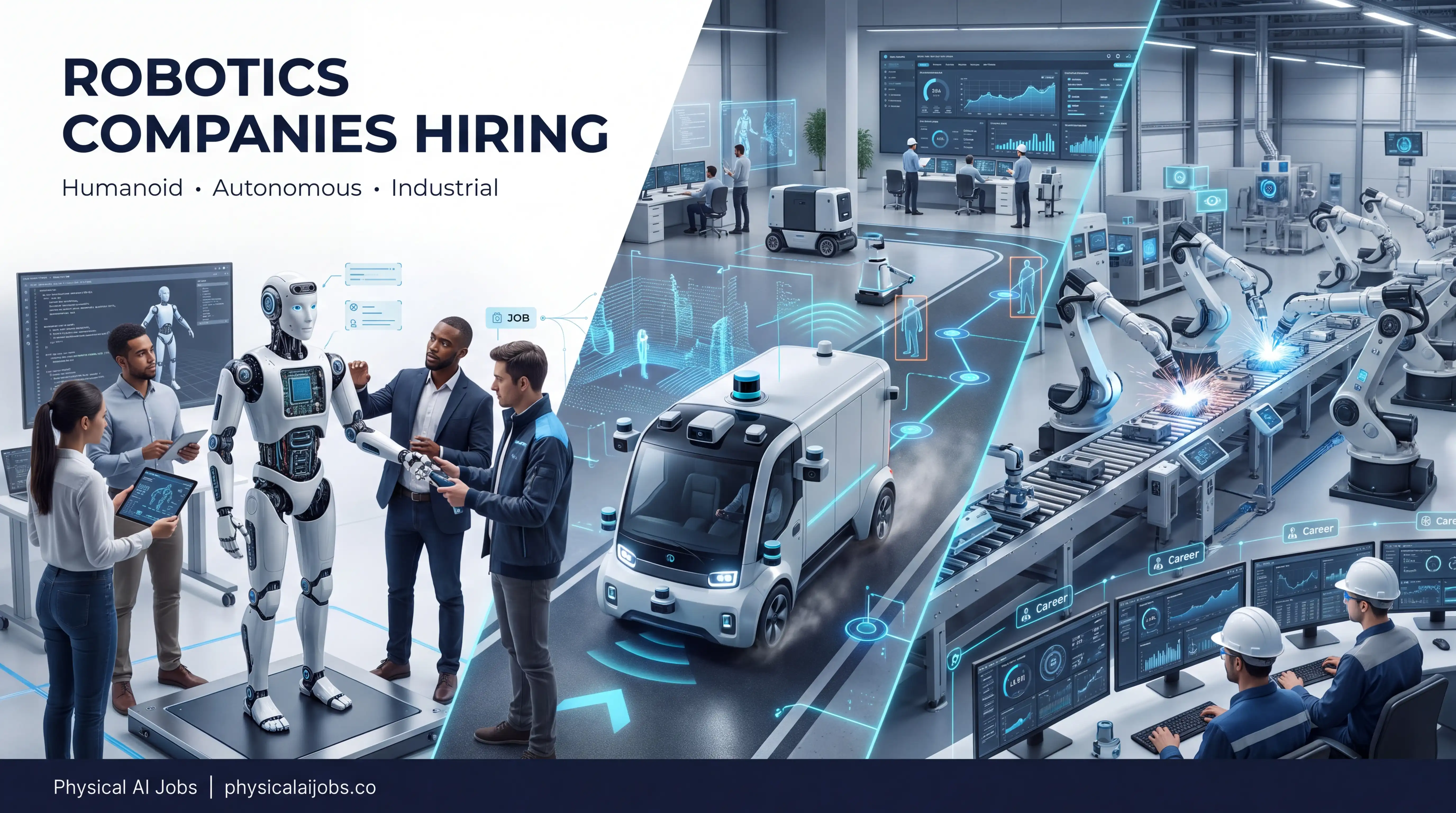
The 20 companies listed here collectively represent the highest volume of active Physical AI and robotics hiring globally as of 2026-27, spanning humanoid robots, autonomous vehicles, warehouse automation, and industrial systems.
-
Compensation at these companies ranges from $90k for entry-level roles to well above $250k in total compensation for senior engineers at well-funded humanoid and autonomous vehicle firms;
-
Most of these companies hire engineers without robotics-specific degrees, provided candidates can demonstrate relevant technical skills and hands-on project experience.
-
Remote work remains limited across this sector; the majority of Physical AI roles require on-site access to hardware, though some software-heavy positions do offer hybrid arrangements.
Keeping track of which companies are hiring can be a real game-changer for a robotics job hunter. The Physical AI market for robotics stretches from multi-billion dollar autonomous vehicle programs to series B funded humanoid robotics start-ups. Not all companies within this space have the same hiring practices or requirements.
We have included a list of 20 robotics companies that are currently hiring and have categorized them based on the type of robotics they specialize in. We have included information on what each company builds, the type and number of roles they hire for, and the skills and traits they look for in candidates, as well as the location of their hiring. We aim to provide you with a research oriented market map, as opposed to a list of companies.
Top Robotics Companies Hiring Right Now
Using the data on job postings, funding updates, and other metrics we track, we have compiled a list of the 20 most consistently hiring robotics companies. These companies are listed by sector, as the type of roles and skills requested can differ greatly.
Humanoid Robot Companies
Humanoid robotics is the fastest-growing hiring segment in Physical AI right now. Companies in this space are focused on developing general purpose robots that can operate in environments designed for humans, which draws on some of the most challenging aspects of the entire field, such as locomotion, manipulation, perception, and safe interaction with humans.
1. Figure AI
Figure is one of the most well-funded humanoid robot companies globally, as they have partnered with many large technology and automotive companies. Their robot can be used in industrial and logistics settings. They are aggressive about recruiting robotics software developers, robotic learning engineers, perception, controls, and simulators. Their roles are mostly located in Sunnyvale, California. Figure recruits engineers that have good fundamentals and a project portfolio instead of qualifications.
2. 1X Technologies
1X was formerly known as Halodi Robotics, a Norwegian company creating humanoid robots for commercial applications. They are located in the US and recruit software, robot learning, and hardware engineers. 1X is known for their learning-based approach in developing behaviors of robots that make it a good fit for individuals with expertise in reinforcement or imitation learning.
3. Apptronik
Apptronik creates Apollo, an industrial humanoid robot from Austin, Texas. The company started as a spin-off from the Human Centered Robotics Lab at the University of Texas. They still have a culture of research-inspired engineering at their company. They recruit software, controls, perception, and hardware engineers and have more focus on controls compared to other similar companies.
4. Agility Robotics
Agility Robotics makes Digit, a bipedal robot used in warehouses in collaboration with Amazon. Based in Salem, Oregon, they are home to one of the most advanced deployments of humanoids in the industry. They recruit talent for robotics software, motion planning, controls, and simulation. Moreover, they have a track record of recruiting highly skilled engineers even if their background is not in humanoids.
5. Physical Intelligence (Pi)
Physical Intelligence is a research company based in San Francisco, that is working on foundational models for robot manipulation. They specialize in training large neural network policies for generalization between multiple tasks and hence make good prospects for candidates who are experts in deep learning and robot learning. Most positions here are highly research-oriented and require an advanced degree in machine learning and robotics.
Autonomous Vehicle Companies
Autonomous vehicles represent one of the largest accumulated investments in Physical AI. Hiring in this sector is more cyclical than in humanoid robotics, having contracted significantly in 2022 and 2023. In 2026-27, several companies are in active growth phases again, particularly those that have reached commercial deployment.
6. Waymo
Waymo is an autonomous vehicle company owned by Alphabet and one of the most technically mature companies in this domain, along with being a very consistent recruiter of robotics talent. Positions are available in perception, prediction, planning, simulation, and software infrastructure. They mainly recruit talent out of San Francisco and Mountain View, California. The recruitment process here is very rigorous and favors those with strong algorithmic foundations and experience at large scale.
7. Zoox
Zoox, founded by Amazon, develops an autonomously engineered vehicle intended specifically for ride-hailing, not based on the conversion of existing vehicles. The architecture is unique compared to most other companies developing AVs, which results in special engineering considerations. They recruit for perception, planning, controls, and safety engineering jobs in Foster City, California.
8. Aurora Innovation
Aurora develops autonomous trucking technology and has already achieved commercialization in terms of freight transport routes in Texas. They recruit for perception, planning, safety, and software engineering roles and have offices in Pittsburgh, San Francisco, and the Dallas-Fort Worth area. Focus of Aurora on freight transport results in unique requirements regarding perception ranges and highway driving scenarios.
9. Motional
Motional, a joint venture of Hyundai and Aptiv, offers a commercial robotaxi service and recruits engineers in software, perception, and autonomous systems fields. The offices of Motional can be found in Boston, Pittsburgh, Santa Monica and Las Vegas. A structured recruiting process is typical for Motional, and prior experience in deploying production software is highly valued.
10. Nuro
Nuro builds small autonomous delivery vehicles and has commercial operations in multiple US cities. They hire for robotics software, perception, planning, and operations engineering. Based in Mountain View, California, Nuro's vehicle size and delivery-focused use case create a somewhat different engineering environment than passenger AV programs.
Warehouse Automation Companies
Warehouse and logistics automation is the sector where Physical AI has reached the widest commercial deployment. These companies are not doing early-stage research; they are scaling systems that already work and need engineers who can improve reliability, throughput, and the range of tasks these systems can handle.
11. Boston Dynamics
Boston Dynamics is one of the most recognized names in robotics globally. Their Spot quadruped robot and Stretch warehouse robot are commercially deployed across multiple industries. They hire for software, controls, perception, and hardware engineering, with headquarters in Waltham, Massachusetts. Boston Dynamics has a demanding engineering culture and tends to hire engineers with strong fundamentals. Their careers page typically lists roles across all major robotics engineering disciplines.
12. Symbotic
Symbotic develops AI-driven warehouse automation solutions for big retailers such as Walmart. Such solutions are built with the use of autonomous mobile robots and advanced software that helps manage inventories and fulfill orders. Symbotic is recruiting for robotics software, controls, computer vision, and systems integration and has headquarters in Wilmington, Massachusetts. The company went public in 2022 and has been scaling heavily since then.
13. Locus Robotics
Locus builds autonomous mobile robots (AMRs) for warehouse picking and fulfillment operations. They hire for software engineering, perception, and systems integration, with a focus on reliable deployment rather than frontier research. Locus is located in Wilmington, Massachusetts, and offers engineers experience in developing systems that have high reliability requirements.
14. Mujin
Mujin is a Tokyo-based robotics company building intelligent robot controllers for industrial and logistics automation. They have a significant US presence and hire for robot software, motion planning, and systems integration. Mujin is notable for hiring engineers interested in working across both hardware and software in a commercially demanding environment. They represent a strong option for candidates interested in Physical AI jobs in Japan or US-based roles with a Japan market focus.
15. Vecna Robotics
Vecna develops autonomous material handling robots for warehouses and factories. The company has headquarters in Waltham, Massachusetts, and hires for robotics software, controls, and systems engineering. Vecna is smaller than other companies on this list, and this provides engineers more freedom when working on the stack.
Industrial Robotics Companies
Industrial robotics covers robot systems for manufacturing, assembly, inspection, and process automation. This is the most established segment of the robotics market, but it is being transformed by the addition of AI-driven perception and decision-making to previously fixed, pre-programmed systems.
16. FANUC
FANUC is the world's largest manufacturer of industrial robots and CNC systems, headquartered in Japan with a major US operation based in Auburn Hills, Michigan. They hire for software, controls, and systems engineering, with an emphasis on reliability and precision engineering. FANUC is an appropriate target for candidates interested in Physical AI roles in Japan or US-based industrial robotics careers with a global scope.
17. ABB Robotics
ABB is a Swiss multinational with one of the largest installed bases of industrial robots globally. Their robotics division hires for software, AI integration, controls, and applications engineering across offices in the US, Germany, Sweden, and beyond. ABB is a strong option for engineers interested in the European market; see our listings for Physical AI jobs in Sweden and Physical AI jobs in Switzerland.
18. KUKA
KUKA is a German industrial robotics company owned by the Chinese appliance manufacturer Midea. They hire for robotics software, controls, and automation engineering, with their primary engineering base in Augsburg, Germany. KUKA is one of the largest employers in the European robotics ecosystem and a key target for candidates exploring Physical AI jobs in Germany.
19. Intrinsic (Google)
Intrinsic is Alphabet's company that focuses on software for industrial robotics, having been formed within X (Google X). It is developing a software platform to enable better programming and deployment of industrial robots through machine learning. It hires software engineers, robot learning engineers, and product engineers, whose locations include mostly Mountain View and other places in the Bay Area. Intrinsic offers a unique chance to work on robotics infrastructure on Google scale.
20. Covariant
Covariant builds AI-powered robotic picking systems for industrial and logistics environments. Their core technology is a general robot learning system called RFM-1 (Robot Foundation Model), designed to allow robots to pick and handle a wide variety of objects without task-specific programming. They hire for robot learning, perception, software, and deployment engineering. Based in Emeryville, California, Covariant has strong research roots and hires engineers with both ML depth and a practical orientation toward deployment.
Among the 20 companies we track most closely, the ones with the fastest hiring velocity in the first half of 2026 are concentrated in 2 segments: humanoid robot companies scaling from prototype to pilot deployment & warehouse automation companies expanding commercial operations. Both segments are hiring across the full stack, not just in ML or software, which means controls, SLAM, and simulation engineers are in particularly high demand right now. - Robotica Network
What Do These Companies Look For in Candidates?
A set of common signals is revealed when analyzing job descriptions and interviews of recruiters in all four areas. There may be small variations among specific positions and companies, but these are the criteria that distinguish candidates who get an interview from those who do not.
Demonstrated hands-on experience with physical hardware. A resume full of machine learning course certificates does not tell a robotics employer, that you can build something that works in the real world. Projects involving real robots, even simple ones, carry significant weight. Our guide on how to build a robotics portfolio covers how to structure and present this work effectively.
Familiarity with ROS 2. This appears in the majority of software and systems engineering job descriptions across all four sectors; It is close to a baseline requirement for most mid-level and above roles.
Strong software engineering fundamentals. Physical AI companies are building production systems that must be reliable, maintainable, and testable. Code quality, version control practices, and experience with CI/CD pipelines matter more than they do in academic or early-stage research contexts.
Domain-specific depth. Generalists can get into this field, but the roles that command the highest compensation and the fastest career growth require genuine depth in at least one specialty: perception, controls, SLAM, motion planning, or robot learning.
Research published in IEEE Spectrum's robotics coverage consistently highlights the gap between demand for Physical AI engineers and the available supply, particularly in controls and embedded systems, which reinforces the value of deep specialization. Academic work on robot learning published through Nature's robot learning research section illustrates the research directions that applied companies are actively drawing from when building their engineering teams.
How Do You Apply to Robotics Companies Effectively?
The application process at robotics companies differs from standard tech hiring in a few important ways.
Apply directly, not just through job boards. Most robotics companies maintain careers pages with more up-to-date listings than third-party aggregators. Check company pages directly for roles that may not have propagated to job boards yet.
Get the terminology right. Mirror the language in the job posting in your resume and cover letter. Applicant tracking systems at larger companies scan for specific terms. If the posting says "ROS 2" and your resume says "ROS," you may be filtered out before a human reads your application. Our guide on common robotics interview questions and how to prepare covers how to handle both technical and terminology challenges in the interview process.
Build a specific portfolio. A GitHub repository with a working ROS 2 project, a robot learning experiment, or a simulation-based planning demo is a concrete signal that matters. Vague descriptions of past work do not carry the same weight.
Target referrals. Robotics is a small industry. Engineers move between companies, and referrals carry significant weight in the hiring process. Engaging with the robotics community through conferences like ICRA and IROS, online communities, and open-source contributions creates the network that generates referrals over time.
Understand the interview format. Most robotics companies run a combination of software engineering assessment, domain-specific technical interviews & a system design round. Humanoid robot and AV companies often include a robotics-specific coding exercise. Preparation should include both standard data structures and algorithms practice and domain-specific problem types such as sensor fusion math, planning algorithm derivation, and control system stability analysis.
Coverage from TechCrunch's robotics coverage tracks funding rounds and hiring announcements in real time, which is a useful signal for identifying which companies are entering growth phases and likely to increase hiring volume.
The robotics job market is more relationship-driven than most engineering sectors. Our data shows that candidates who secure referrals convert to offers at a rate roughly 3 times higher than cold applicants, even when their technical qualifications are equivalent. Building visibility in the robotics community before you need a job is consistently one of the highest-return activities for engineers targeting this field. - Physical AI Jobs
What Are the Salary Ranges at These Companies?
The compensation in robotics is very different depending on the kind of company, its funding level, location, and position. These ranges show the base salary in the USA, obtained from the compensation data we gathered on the platform.
| Sector | Entry Level | Mid Level | Senior Level |
|---|---|---|---|
| Humanoid Robots | $100K to $130K | $140K to $195K | $200K to $280K+ |
| Autonomous Vehicles | $110K to $140K | $150K to $200K | $210K to $290K+ |
| Warehouse Automation | $90K to $120K | $125K to $170K | $175K to $230K |
| Industrial Robotics | $85K to $115K | $115K to $160K | $160K to $210K |
Equity is a significant component of total compensation at venture-backed startups. An offer at a series B humanoid robot company with a $130k base may include equity that substantially raises the effective value of the package depending on the company's trajectory.
For a full breakdown by role rather than sector, see our guide on the highest-paying robotics and Physical AI careers.
Salary ranges in international markets differ considerably. Germany, Switzerland, and the Netherlands offer strong compensation by European standards, while Japan and South Korea pay well relative to local cost of living. Explore our location guides for Physical AI jobs in Germany, Physical AI jobs in the Netherlands, and Physical AI jobs in South Korea for regional context.
What Does Career Growth Look Like at These Companies?
Career progression in robotics companies tends to follow one of two models depending on company size and stage.
At startups and scale-ups (most humanoid and early-stage AV companies), career growth is fast but less structured. Strong engineers gain broad scope quickly, often owning systems end-to-end within a year or two. Titles and levels matter less than impact. The tradeoff is that the path to management or principal-level roles is less clearly defined and depends heavily on company growth.
At larger, established companies (FANUC, ABB, Waymo, Amazon Robotics), career ladders are more formal. Progression from mid to senior typically takes three to 5 years with clear criteria. The advantage is mentorship, process maturity, and stability. The tradeoff is that scope is narrower and iteration cycles are slower.
For engineers earlier in their careers, the question of which environment suits you better is worth thinking through carefully. Our guide on how to get entry-level robotics jobs covers how to evaluate companies at different stages and what to look for beyond salary and job title.
For those still building toward their first robotics role, the guides on what skills you need for robotics careers and whether you need a degree for robotics are practical starting points before targeting specific companies.
About the Author
Physical AI Jobs Board is passionate about the future of physical AI and robotics careers. Our goal is to help job seekers, engineers, and researchers navigate this fast-growing industry by providing in-depth guides, company insights, and the best career opportunities in the world of embodied intelligence.