Key Takeaways
-
Eight distinct entry-level roles exist in robotics that do not require prior industry experience, ranging from technician positions to junior developer and QA roles.
-
The average entry-level robotics salary in the United States sits between $65k and $95k, with junior software-adjacent roles reaching higher at companies with venture backing;
-
ROS 2, Python, and one hands-on hardware project are the three credentials that appear most consistently in entry-level robotics job postings across all role types.
-
Robotics internships are widely available at both large companies and startups and remain the most reliable conversion path to a full-time entry-level offer.
A lot of people find getting their first robotics job confusing. The sector is overwhelming at face value; job descriptions involve SLAM, control theory, ROS 2, and real-time systems, and most people feel like they aren't fit enough for the job. Many times, these people are wrong.
There are entry-level jobs available in the robotics sector, and companies are hiring. Companies require robotics technicians, junior software developers, data acquisition operators, QA testing personnel, and even junior robotics engineers in all the major specializations. The only thing required here is not experience but competency in the necessary fundamentals, proof that one can handle physical hardware, and quick learning.
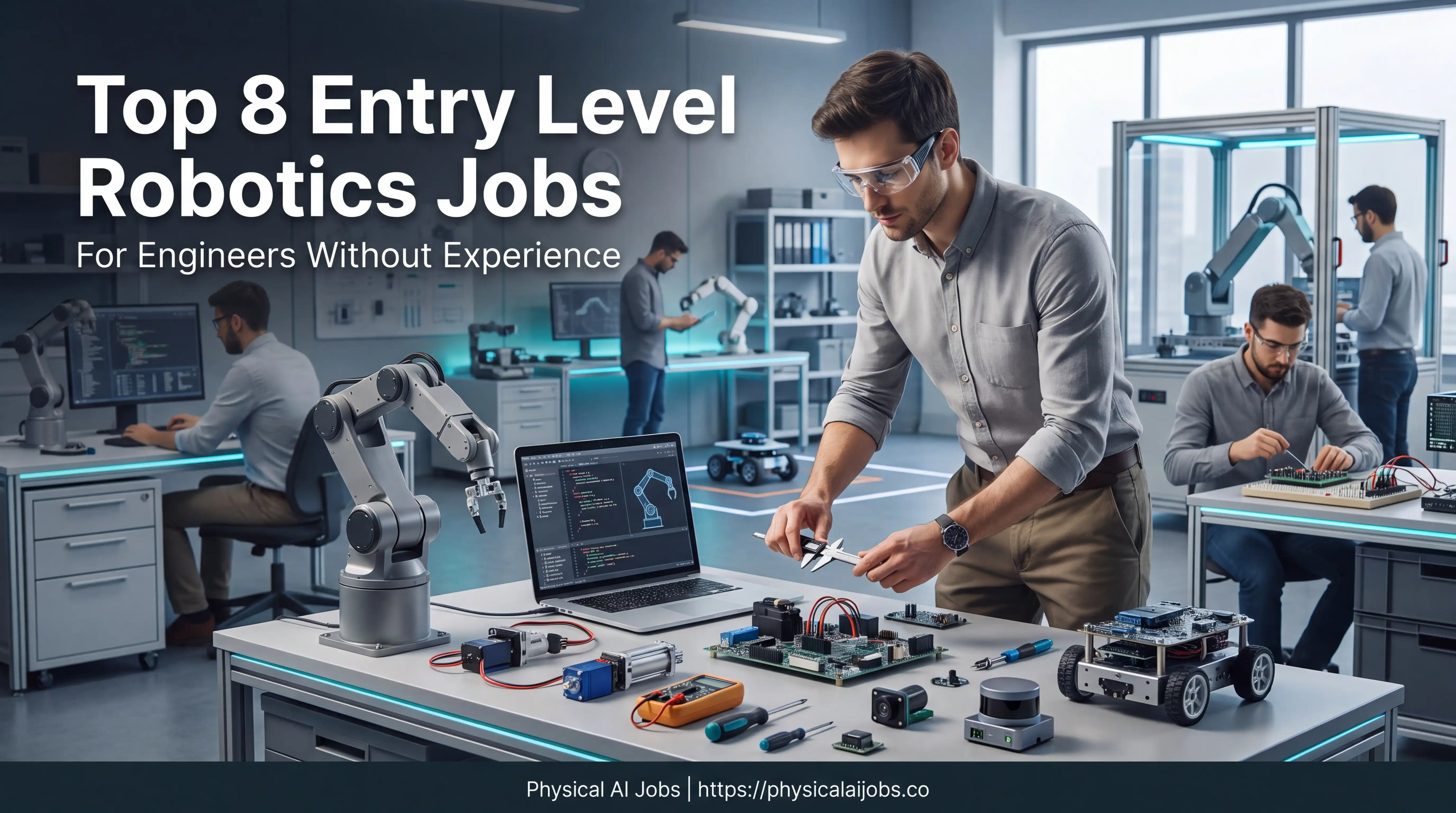
The following are the most common and easiest robotics jobs one can land and earn a living from, along with how to qualify for them and other relevant information.
What Are the Easiest Entry Level Robotics Jobs to Get?
The easiest access points to the robotics industry are those positions that value practical skill set and trainability rather than deep knowledge of a particular field. They are not easy positions, but they don't require a PhD, years of experience, or knowledge of all tools used in robotics.
The following eight positions are arranged roughly from the most to the least accessible in terms of the minimal hiring criteria described in the entry-level job postings and shared by hiring teams. All positions listed below were successfully occupied by candidates coming from other areas of expertise or freshly graduated from the university.
1- Robotics Technician
What the role involves: Robotics Technicians install, maintain, calibrate and repair robotic systems in manufacturing, logistics, or research environments; This is a hands-on hardware role. Day-to-day work includes mechanical assembly, wiring, troubleshooting faults, running diagnostic software, and coordinating with engineers when systems behave unexpectedly. Technicians are the people who keep deployed robots running reliably.
Why it is accessible: This role prioritizes practical skill over theoretical depth. Candidates with a background in mechanical technology, electrical technology, or even skilled trades often qualify. A two-year associate degree in a relevant field or a vocational certification is frequently sufficient.
Core skills required: Basic electronics and mechanical aptitude, ability to read technical documentation and wiring diagrams, comfort with hand tools and testing equipment, and familiarity with the type of systems used at the employer (industrial arms, AMRs, or research platforms).
Typical entry-level salary (US): $45k - $70k. Technician roles at automotive manufacturers and large logistics companies tend to sit at the upper end of this range.
How to get it: Build hands-on experience with any physical system, A robotics club project, a personal electronics build, or experience in manufacturing or maintenance work all count. Certifications in electrical systems or programmable logic controllers (PLCs) are a genuine advantage.
2- Junior ROS 2 Developer
What the role involves: Junior ROS 2 Developers develop and maintain ROS 2-based robotic systems software. Junior ROS 2 Developers' entry-level duties include building and testing ROS 2 nodes, developing drivers for sensors and actuators, solving communication problems between software modules, and assisting senior software engineers in their work.
Why it is accessible: ROS 2 is learnable independently. Candidates who have worked through the official tutorials and built a project that runs on real or simulated hardware have a credible foundation. Companies hiring at this level are explicitly willing to train candidates with the right base.
Core skills required: Python and basic C++, ROS 2 fundamentals (nodes, topics, services, actions), Linux command line, Git, and the ability to read and understand existing codebases. A working ROS 2 project in your portfolio is close to a requirement.
Typical entry-level salary (US): $75k - $105k at software-adjacent companies. Pure hardware companies may sit slightly lower.
How to get it: Complete the official ROS 2 tutorials at docs.ros.org, then build a project that uses at least three ROS 2 concepts together in a working system. Document it on GitHub. The ROS community forum at ROS Discourse is an active resource for getting unstuck and for showing engagement with the community, which hiring managers notice.
3- Data Collection Operator
What the role involves: Data Collection Operators operate robots or sensors through controlled environments in order to produce the training and validation data used by machine learning teams to develop Physical AI systems. The job requires driving robot platforms in the field, labeling sensor data, maintaining data pipelines, and ensuring data quality. It may not be glamorous work, but it is important work and allows candidates direct access to the Physical AI development process.
Why it is accessible: This is one of the lowest technical barrier entry points into Physical AI. Many data collection roles require only a driver's license (for vehicle data collection), physical fitness, basic computer literacy, and the ability to follow structured protocols consistently.
Core skills required: Attention to detail, ability to follow precise operational procedures, basic data handling skills, and for some roles, familiarity with annotation tools or sensor hardware. Experience operating any vehicle or robotic platform is an advantage.
Typical entry-level salary (US): $40k - $65k. AV data collection roles at well-funded companies often include overtime and travel pay that raises effective compensation.
How to get it: Target autonomous vehicle companies and humanoid robot firms with active deployment programs. These organizations run continuous data collection operations and hire at scale for this role. Physical AI jobs in the USA and Canada show the highest concentration of these positions.
4- Controls Engineer Intern
What the role involves: Controls Engineer Interns assist the team that converts robot decision-making into hardware commands such as motor commands. Interns in this position typically do simulation testing, algorithm testing, performance data collection on the hardware, and documentation. This is an excellent entry position for those with mechanical or electrical engineering backgrounds.
Why it is accessible: Internships by definition accommodate candidates without full professional experience; Companies offering controls internships are looking for candidates who understand the theoretical foundations of control systems and are ready to apply them under supervision.
Core skills required: Control theory fundamentals (PID, state space basics), MATLAB or Python for simulation, basic familiarity with robotics dynamics, and ideally some exposure to ROS 2. A relevant engineering degree in progress is typically expected.
Typical intern compensation (US): $25 to $45 per hour, with full-time conversion offers common at the end of successful internships.
How to get it: Apply through university recruiting pipelines at robotics companies. Build a controls-related project, even a simple line-following robot with PID control, to demonstrate applied understanding. See open controls engineer roles for a sense of what full-time positions in this field look like and what to build toward.
5- Simulation Engineer Entry Level
What the role involves: Simulation Engineers at the entry level build the simulated environments where robotic systems can be trained and tested. It entails designing simulations, integrating URDF models, setting physics parameters, and scripting the tests. It is a mostly software-based job with little hands-on experience with robotics hardware compared to other roles in the field..
Why it is accessible: Simulation engineering is more approachable for candidates coming from pure software backgrounds; because it does not require direct hardware experience. Strong Python skills, curiosity about 3D environments, and familiarity with at least one simulation platform are a workable foundation.
Core skills required: Python, ROS 2 basics, familiarity with a simulation platform (Gazebo, Isaac Sim, or MuJoCo), basic 3D spatial reasoning, and scripting skills for test automation. Experience with game engines like Unity or Unreal is transferable and valued.
Typical entry-level salary (US): $80k - $110k. Simulation roles at companies with large ML training pipelines often sit at the higher end.
How to get it: Set up Gazebo or a similar simulator locally, build a simulated robot environment from scratch, and document the process. This single project answers the most common screening question for this role: "Have you actually used a simulator?" See open simulation engineer positions on the platform.
Research from ETH Zurich's Robotics Systems Lab consistently demonstrates how simulation fidelity directly affects the quality of trained robot policies, which underscores why companies invest heavily in simulation engineering even at early hiring stages.
6- Junior Perception Engineer
What the role involves: Junior Perception Engineers help build and test systems that allow robots to perceive the world around them through sensing devices. At the entry level, this work includes data annotation and review, inference of trained models, testing model performance on new data sets, and scripting perception tests. While senior engineers have ownership of the architecture, junior engineers have ownership of the validation and iterations.
Why it is accessible: Candidates with a background in computer vision coursework, even from a university course or online program, can contribute meaningfully at this level; The role is a strong fit for recent graduates from CS or electrical engineering programs who have taken a machine learning or computer vision course.
Core skills required: Python, PyTorch or TensorFlow basics, understanding of convolutional neural networks and object detection models, familiarity with image processing libraries (OpenCV), and ideally some experience with labeled datasets. ROS 2 exposure is a plus.
Typical entry-level salary (US): $85k - $115k. Perception roles at AV companies trend higher given the field's talent scarcity.
How to get it: Train an object detection model on a public dataset (COCO, KITTI, or similar), evaluate it on real-world images, and document the results clearly. This is a standard junior perception exercise that gives you something concrete to discuss in interviews. Browse open perception engineer jobs to calibrate what full-level roles require and what to work toward.
7- Robotics QA Tester
What the role involves: Robotics QA Testers write and conduct tests that ensure robotic software and hardware operate as expected. They do this by scripting automated tests, performing regression tests prior to releasing new versions of software, tracking bugs, and working with engineers to find root causes of the problems. QA in robotics is more complicated than QA in software development due to the complexity of robotic systems.
Why it is accessible: This is one of the most accessible technical roles in robotics for candidates transitioning from general software QA backgrounds. Understanding of software testing principles transfers directly; the robotics domain knowledge is learnable on the job.
Core skills required: Python for test scripting, familiarity with testing frameworks, ability to write clear and reproducible bug reports, attention to detail, and comfort with Linux environments. ROS 2 familiarity is a significant advantage.
Typical entry-level salary (US): $70k - $95k. QA roles at safety-critical companies (surgical robotics, AV) often pay more given the compliance demands.
How to get it: Write automated tests for any robotics-adjacent project you have built, even a simple simulation. The ability to demonstrate that you think systematically about failure cases is the core hiring signal for this role.
8- Field Robotics Engineer
What the role involves: Field Robotics Engineers install, manage, and repair robotic systems in customers' offices or factories, research facilities, or operational settings which are outside a typical laboratory or factory environment. The position requires substantial traveling, practical hardware experience, the ability to resolve problems on-site when systems malfunction, and feedback gathering from the field that helps the engineering team at headquarters.
Why it is accessible: Field roles are often overlooked by candidates who are focused on lab or office-based engineering positions. But they offer early, broad exposure to how robots actually perform in uncontrolled environments, which is some of the most valuable learning available in the industry.
Core skills required: General robotics software familiarity (ROS 2 basics helpful), hardware troubleshooting skills, ability to work independently under pressure, strong communication skills for customer or partner interaction, and a valid driver's license. Some roles require physical fitness and comfort working in industrial or outdoor environments.
Typical entry-level salary (US): $65k - $90k, often with travel and expense coverage that increases effective compensation.
How to get it: Highlight any experience operating complex systems in unpredictable environments, from field research to equipment maintenance to competitive robotics. The ability to stay calm and solve problems when hardware fails under pressure is what these hiring teams are screening for.
Our review of entry-level robotics postings shows that Field Robotics Engineer is consistently among the fastest roles to fill, partly because fewer candidates apply for it. Engineers focused exclusively on software-heavy lab roles overlook it; yet it offers some of the broadest early-career exposure in the industry. Candidates who take field roles often advance faster because they develop an intuition for real-world system behavior that lab engineers acquire much later. - Physical AI Jobs
What Skills Do You Need for Entry Level Robotics Jobs?
Across all the above-mentioned job titles, there are three skills which recur often enough to be called basic requirements for almost any entry-level robotics job:
Python: The dominant language for robotics software, AI, and data processing; Every role in this list either requires Python directly or benefits significantly from it. If you write Python competently, you have the foundational language skill for this field.
ROS 2: The standard middleware for modern robotics. ROS 2 fluency is listed in the majority of software-adjacent entry-level postings; Even technician and QA roles increasingly reference it. Working through the official tutorials and building one project that uses ROS 2 in a meaningful way is the single highest-return investment a robotics job seeker can make.
Hands-on hardware experience: This is the hardest requirement to fake and the one most candidates underestimate. It does not mean you need to have worked in industry. It means you need to have built something physical and made it work. A mobile robot, a robotic arm, a sensor integration project, or even a competitive robotics build all qualify. Our guide on how to build a robotics portfolio walks through exactly how to structure and document this work for maximum hiring impact.
Secondary skills that appear frequently across entry-level postings include: Linux command line, Git, C++ basics, basic linear algebra and probability, and familiarity with at least one simulation environment.
For structured skill-building, The Construct offers ROS-focused online courses specifically designed for engineers building toward their first robotics role, with a simulated robot environment built into the learning platform. The Robotics Stack Exchange is a useful resource for getting answers to specific technical questions as you work through projects and encounter problems.
How Do You Build a Portfolio for Entry Level Robotics Jobs?
A robotics portfolio is not a bunch of screenshots of your course materials. It is proof that you can make something that works. People who hire robotics engineers review dozens of CVs of applicants with online classes. What makes some candidates get an interview is having a GitHub account with a working robot.
Three portfolio projects cover the ground that entry-level hiring teams care most about:
Project 1: A ROS 2 mobile robot. Build a simulated or physical mobile robot in ROS 2 that navigates between waypoints using a basic sensor; This demonstrates ROS 2 fundamentals, spatial reasoning, and the ability to integrate multiple components into a working system.
Project 2: A perception or vision system. Train a simple object detection model, deploy it in ROS 2 or as a standalone Python application, and document its performance on test data; This demonstrates machine learning fundamentals applied to physical sensing.
Project 3: A controls experiment. Implement PID or another control algorithm on a physical system, tune the parameters, and document the results. A simple balancing robot or motor speed controller is sufficient. This demonstrates that you understand feedback control in practice, not just in theory.
Each project should have a clear README explaining what it does, what challenges you solved, and what you would do differently. Video documentation of the system running is a significant advantage.
Which Companies Are Hiring Entry Level Robotics Engineers?
Entry-level recruitment is not uniformly spread within the robotics industry. Growing startups, companies with intern programs, and companies with heavy deployment are the main sources of entry-level positions.
Humanoid robot companies including Figure AI, Agility Robotics, and 1X are actively hiring across all experience levels as they scale from prototype to pilot deployment. They tend to move fast in hiring and are willing to take bets on candidates with strong fundamentals.
Autonomous vehicle companies including Waymo, Aurora, and Motional run large internship programs that convert to full-time offers. Entry-level hiring outside of internship conversion is more competitive and tends to favor candidates with specific domain experience.
Warehouse automation companies including Symbotic, Locus Robotics, and Vecna Robotics hire technicians, junior software engineers, and field engineers at consistent volume due to the demands of commercial deployment at scale.
Industrial robotics companies including ABB, FANUC, and KUKA hire for technician and junior engineering roles in large volumes, particularly in Germany, Japan, and the US industrial belt. These roles offer stability and structured career progression. See our guides for Physical AI jobs in Germany and Physical AI jobs in Japan for regional context.
Beyond job boards, the Robotica Network's Physical AI and robotics job listings aggregates roles from across the global Physical AI ecosystem, including positions at companies that do not advertise widely through standard channels. It is worth checking alongside our own listings when targeting entry-level roles.
Entry-level candidates who make it to final-round interviews at robotics companies almost always have one thing in common:- they can point to a specific moment where something they built failed, explain what they learned from the failure, and describe what they changed. Robotics hiring teams are not just evaluating technical skill; they are evaluating how you think about physical systems under uncertainty. That mindset is what separates candidates who get offers from those who do not. - Physical AI Jobs
For a full map of which companies across all sectors are currently hiring across experience levels, see our guide on robotics companies actively hiring.
Frequently Asked Questions
What is the easiest entry level robotics job to get?
Robotics Technician and Data Collection Operator are the most accessible entry points, requiring practical aptitude over deep technical specialization. For candidates with a software background, Junior ROS 2 Developer and Robotics QA Tester are the most accessible roles. The right answer depends on your existing background.
Do I need a degree for entry level robotics jobs?
Not always. Technician roles are frequently filled by candidates with vocational training or associate degrees. Software-adjacent roles favor candidates with bachelor's degrees in CS, EE, or ME, but companies are increasingly open to strong self-taught candidates who can demonstrate relevant skills through a portfolio. Our full guide on whether you need a degree for a robotics career covers this by role type.
What is the average entry level robotics salary?
Entry-level robotics salaries in the United States range from around $45k for technician roles to $115k for junior perception or simulation engineering roles at well-funded companies. The median across all entry-level robotics roles sits roughly between $70k and $90k. For a role-by-role breakdown, see our guide on the highest-paying robotics careers.
How can I get a robotics job with no experience?
Build ROS 2 project experience independently, create at least one portfolio project involving physical hardware, and apply to internships and technician roles that explicitly welcome entry-level candidates. Engaging with the robotics community through forums like ROS Discourse and events like local robotics meetups also creates the relationships that generate referrals. Our full guide on how to start a career in robotics covers the step-by-step path.
Are robotics internships available?
Yes. Most major robotics companies run structured internship programs, including Waymo, Aurora, Agility Robotics, Boston Dynamics, ABB, and many others. Internships typically run in summer months, with applications opening three to six months in advance. Conversion rates from intern to full-time offer are high at companies where the internship is structured around a real project.
What skills do I need for my first robotics job?
The core three are Python, ROS 2, and hands-on hardware project experience. Secondary skills that strengthen your candidacy include Linux command line, C++ basics, Git, and familiarity with at least one simulation platform. For a full breakdown of skills by role type, see our guide on what skills you need for a robotics career.
About the Author
Physical AI Jobs Board is passionate about the future of physical AI and robotics careers. Our goal is to help job seekers, engineers, and researchers navigate this fast-growing industry by providing in-depth guides, company insights, and the best career opportunities in the world of embodied intelligence.