Key Takeaways
-
Physical AI is artificial intelligence embedded in machines that perceive, decide and act in the real world, combining robotics, machine learning, and control systems.
-
Unlike traditional AI, Physical AI must operate in unpredictable environments where sensor noise, timing, and physical consequences make failures far more costly.
-
The field spans dozens of distinct roles including perception engineer, SLAM engineer, motion planning engineer, and controls engineer; all with strong and growing hiring demand.
-
You do not need a research background to enter Physical AI: engineers with hands-on project experience, ROS 2 knowledge, and simulation skills are actively hired at entry level.
Physical AI is one of the fastest-growing fields in technology. But for most people, the term is still new and a little vague. Is it just robotics? Is it related to ChatGPT? How is it different from the AI that recommends your next Netflix show?
We have the answers for you. After reading our guide, you will better understand physical AI, the gaps you have with traditional AI and embodied AI, and what physical AI encompasses. You will also have a better understanding of the careers physical AI will open doors to. This guide is for you tired professionals, students contemplating their career paths, and engineers considering a career switch. This guide is easier to explain, and it is validated and backed by research.
What is Physical AI?
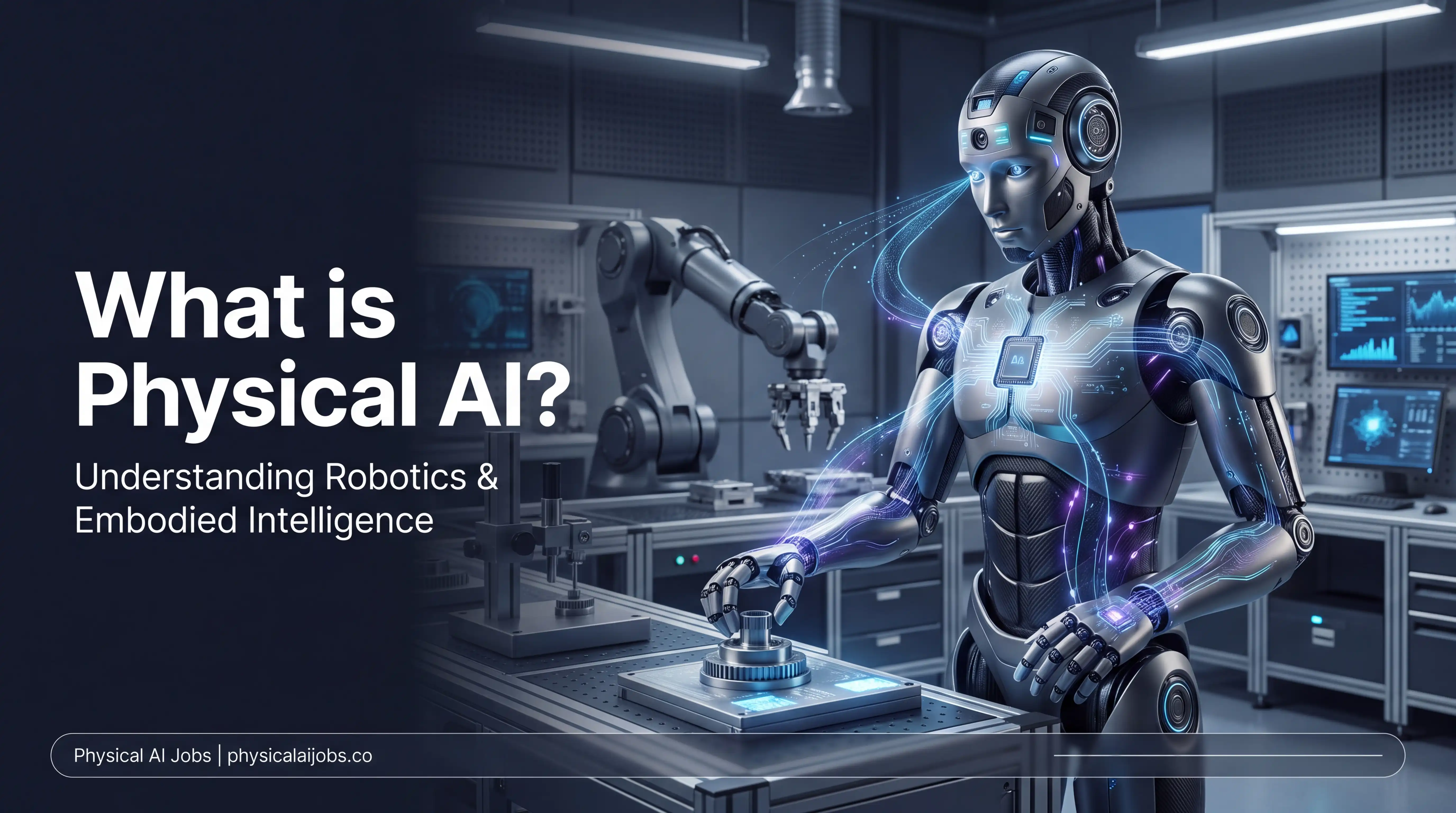
Physical AI refers to artificial intelligence systems that perceive, reason about, and act within the physical world. Unlike software-only AI, Physical AI is embedded in machines that move, touch, navigate, and interact with real environments. Think of a robot arm sorting packages in a warehouse, a self-driving vehicle making lane decisions in real time, or a humanoid robot carrying boxes on a factory floor.
The most interesting and unique aspect of Physical AI is the closed-loop system of sensing, thinking, and doing. The system can gather information from the outside world through the use of various types of microphones, cameras, and sensors. The gathered data is processed using different types of machine learning models, and from there the system can take action. That action will affect the physical world, and the closed-loop process will begin all over again.
Physical AI is nothing by itself, and to realize the concept it requires the joining of many different areas including control systems, machine learning, robotics, sensors, and computer engineering. Physical AI is the result of the coming together of all of those fields.
The concept of Physical AI is often seen in the products of many big tech companies. As an example, the robotics and autonomous systems platforms of NVIDIA are described using the term Physical AI with the Jetson edge computing products and Isaac simulation tools. However, the term is larger than just any single company and its products.
How Does Physical AI Differ from Traditional AI?
Traditional AI, in the modern sense, typically refers to software models that process data and generate outputs inside a computer. A large language model reads text and writes text. An image classifier looks at a photo and returns a label. A recommendation engine analyzes your behavior and suggests content.
These systems pack a punch. But they live entirely in the digital world. They do not have to account for gravity. They do not have to try to not break a pack of cards. They do not have to figure out a way to walk around a room with a moving dummy that rearranges the furniture every time they walk in.
Physical AI does all of that. The table below captures the core differences:
| Dimension | Traditional AI | Physical AI |
|---|---|---|
| Environment | Digital only | Physical world |
| Input | Text, images, structured data | Sensors, cameras, lidar, touch |
| Output | Text, labels, predictions | Motor commands, movement, force |
| Key challenge | Accuracy, reasoning, scale | Real-time response, safety, uncertainty |
| Failure modes | Hallucination, bias | Collision, damage, system failure |
| Example | GPT-4, image classifiers | Autonomous vehicles, robot arms |
The results are also different. A language model can be wrong and just be told so. When a Physical AI system is wrong and is moving, the consequences are real and can be catastrophic. This is the reason why the three areas of safety, reliability, and real-time performance are of utmost importance.
Is Physical AI the Same as Embodied AI?
These two terms overlap significantly, but they are not identical. Understanding the distinction helps when you are reading job postings or academic literature.
Embodied AI is a research concept rooted in cognitive science and philosophy; It refers to the idea that intelligence requires a body to develop and function. An embodied AI system learns about the world by interacting with it physically, similar to how humans develop spatial understanding through movement and touch. Embodied AI is primarily a framework for thinking about how intelligence should be built.
Physical AI is the broader industry and engineering term; It includes embodied AI systems, but it also covers machines that are highly capable without necessarily having the kind of open-ended learning that embodied AI research pursues. An industrial robot arm running a trained perception model is Physical AI. It may or may not be "embodied" in the research sense, depending on how it was trained and how it adapts.
In most cases, Physical AI and Embodied AI are used as synonyms in enterprise information systems or in roadmaps for emerging technologies. To learn more about how the two diverge, please see the section of the comprehensive guide dedicated to this topic: Physical AI vs Embodied AI
How Does Physical AI Work?
A Physical AI system operates through a continuous cycle of perception, decision-making, and action. Here is how each layer functions:
Perception
The system gathers data from its environment using sensors. Common inputs include RGB cameras, depth cameras, lidar (light detection and ranging), radar, IMUs (inertial measurement units), and force-torque sensors on robot arms. The raw sensor data is noisy and high-dimensional. The first challenge is making sense of it.
Deep learning models, especially convolutional neural networks and transformer-based vision models, process this sensor data to detect objects, estimate distances, track movement, and build a representation of the surrounding environment.
Localization and Mapping
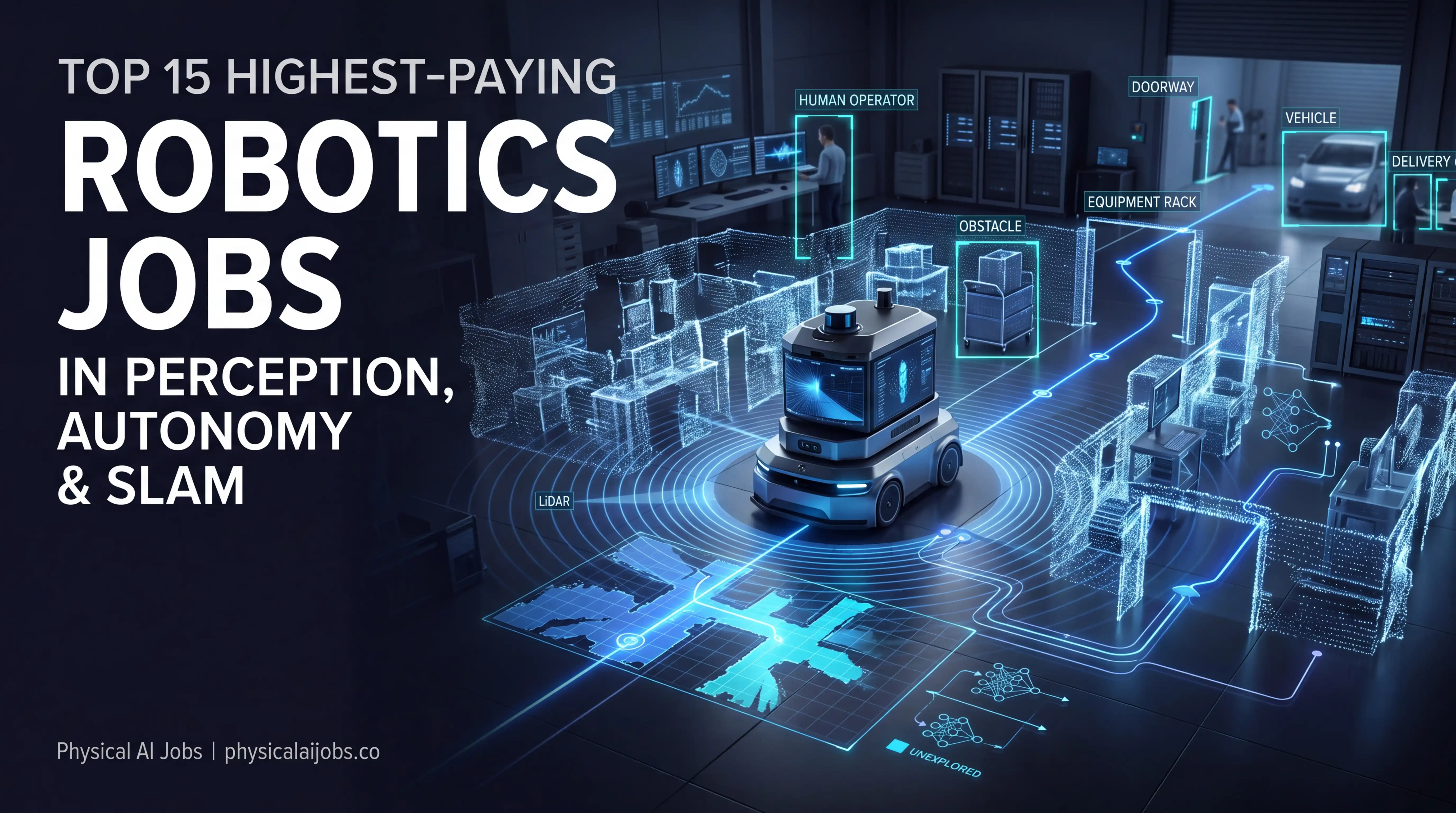
To operate, most Physical AI systems need to have an understanding of where they are in the spatial sense. SLAM, or Simultaneous Localization and Mapping, is the method of simultaneously mapping an environment and keeping track of where the system is in that environment. This is very important for the design of mobile robots and autonomous vehicles and very much creates a demand for these engineers. Please see the available positions for SLAM engineering.
Decision-Making and Planning
After a system locates itself in its environment, the question becomes: what should it do? This is the layer of autonomy and motion planning. Systems of this nature consider multiple options and, given a myriad of real-world limitations, decide on a course of action.
Modern Physical AI increasingly uses reinforcement learning and foundation models trained in simulation to handle this layer. The sim-to-real pipeline, training in virtual environments like NVIDIA Isaac Sim or DeepMind's MuJoCo and then deploying on real hardware, has become a standard approach.
Action and Control
The final layer translates decisions into physical commands. A controls engineer designs the systems that tell motors, actuators, and joints exactly how much force and speed to apply, and at what timing. Getting this right requires deep knowledge of dynamics, feedback control, and hardware limitations.
This is one of the most specialized and in-demand skills in Physical AI. Explore open Controls engineering Jobs on our platform.
What Physical AI Job Roles Exist?
Physical AI is not a single job title. It is a category that spans dozens of distinct roles across engineering, research, and applied science. The most common include:
-
Robotics Software Engineer: Builds the software stack that runs on robots, including perception pipelines, planning algorithms, and system integration.
-
Perception Engineer: Specializes in computer vision and sensor fusion, helping systems understand what they are seeing.
-
Motion Planning Engineer: Designs algorithms that determine how a robot moves from A to B safely and efficiently;
-
Controls Engineer: Handles the low-level systems that translate decisions into physical commands to motors and actuators.
-
Simulation Engineer: Builds and maintains the virtual environments used to train and test Physical AI systems before real-world deployment.
-
SLAM Engineer: Focuses on localization and mapping, critical for any mobile robot.
-
ML Engineer (Robotics): Applies machine learning specifically to robotics problems, including training on real or simulated data;
-
Autonomy Engineer: Works on the decision-making systems that allow robots or vehicles to operate without human intervention.
Browse the full list of open Physical AI jobs and robotics jobs on our platform.
Based on our analysis of over 3,000 Physical AI job listings posted in the past 12 months, the roles with the highest hiring velocity are perception engineers, motion planning engineers & simulation engineers. These three functions represent the core of how companies are scaling their Physical AI development pipelines.- Physical AI Jobs
What Skills Do You Need for a Physical AI Career?
The skill set for Physical AI careers combines software engineering, mathematics, and domain-specific robotics knowledge. The exact mix depends on your role, but these are the foundations that appear consistently across job listings:
Core Programming: Python is the dominant language for AI and robotics development, C++ is essential for performance-critical systems and hardware-level code. Most roles require both.
ROS / ROS 2: The Robot Operating System (now primarily ROS 2) is the standard middleware for robotics development, Familiarity with ROS 2 is listed in the majority of robotics job postings. See open ROS 2 jobs to understand what employers expect.
Machine Learning: Understanding of neural networks, computer vision models (CNNs, ViTs), and reinforcement learning is increasingly required even for non-research roles.
Linear Algebra and Probability: The mathematics of transformation, rotation, state estimation, and uncertainty management underpins most of the algorithms used in Physical AI.
Simulation Tools: Experience with Isaac Sim, Gazebo, MuJoCo, or similar environments is a significant advantage, especially for roles involving training or validation.
Control Theory: For controls and hardware-adjacent roles, classical and modern control theory is non-negotiable.
For a full breakdown, read our guide on what skills you need for robotics.
What Are the Career Paths in Physical AI?
Physical AI careers tend to develop along one of three tracks:
The Research Track leads through academia or corporate research labs; Researchers publish work on new algorithms, training methods, and hardware architectures. Entry typically requires a Master's or PhD in robotics, computer science, or electrical engineering.
The Engineering Track is the most common path; Engineers build and maintain the systems that run in production. Entry level roles are available to strong candidates with relevant degrees and hands-on project experience. Read our guide on how to get entry-level robotics jobs.
The Applied Science Track bridges research and production; Applied scientists take research results and adapt them to work reliably at scale. This hybrid role has grown significantly as companies move from prototypes to deployment.
For those coming from adjacent fields, the transition is more accessible than many assume. Our guide on transitioning from software engineer to robotics engineer covers exactly how to make that shift.
We consistently see software engineers making successful transitions into Physical AI roles within 12 - 18 months when they focus on three areas: learning ROS 2, building a hands-on hardware project & gaining experience with a simulation environment. Candidates who do this demonstrate practical credibility that hiring teams respond to. - Physical AI Jobs
Where is Physical AI Being Applied?
Physical AI is no longer limited to academic labs or science fiction. It is being deployed across a wide range of industries:
Manufacturing and Logistics: Robot arms, autonomous mobile robots (AMRs) & AI-guided quality inspection systems are standard in modern warehouses and factories. Many companies like Boston Dynamics, Agility Robotics, and Mujin operate in this space.
Autonomous Vehicles: Self-driving cars, trucks, and delivery robots represent one of the largest investments in Physical AI globally. Waymo, Cruise, and dozens of startups are active here .
Healthcare and Surgery: Surgical robotics platforms like the Da Vinci system use Physical AI to assist surgeons with precision tasks. Rehabilitation robots and hospital logistics robots are growing sectors .
Agriculture: Autonomous tractors, drone-based crop monitoring, and robotic harvesting systems are reducing labor costs and improving yield in precision agriculture.
Defense and Safety: Inspection robots for hazardous environments, search and rescue systems, and perimeter security applications are expanding uses of Physical AI in high-stakes settings.
Consumer and Service Robotics: Humanoid robots & home assistants are emerging from prototype phase. Companies like Figure, 1X and Apptronik are building general-purpose robots aimed at domestic and light commercial use.
According to research published by the IEEE, the global market for industrial robotics alone is projected to reach significant scale over the next decade, with AI-enabled systems representing the fastest-growing segment. IEEE Spectrum's robotics coverage provides ongoing reporting on where the technology is heading.
For a global view of where Physical AI jobs are concentrated, explore our location pages including Physical AI jobs in the USA, Germany, Japan, and South Korea.
How Do You Get Started in Physical AI?
If you are new to the field, the path forward is clearer than it might seem. Here is a practical starting sequence:
1. Assess your current foundation. If you already write Python, understand basic linear algebra, and have worked on software projects, you have a workable base. If not, those are your first priorities.
2. Learn ROS 2. The official ROS 2 documentation is comprehensive. Work through the beginner and intermediate tutorials with a physical or simulated robot.
3. Build something physical. A mobile robot, a robotic arm, or even a simulation-based project demonstrates that you can work with real systems. Employers in Physical AI weight hands-on experience heavily. Our guide on how to build a robotics portfolio walks through exactly how to structure this.
4. Choose your specialization. Perception, planning, controls, and simulation are all distinct career paths. Pick the one that matches your background and interests and go deep. Browse our job categories to see which roles are actively hiring and what they require.
5. Consider certifications. While not always required, structured certifications signal commitment. Read our breakdown of what robotics certifications you need to evaluate your options.
6. Study how companies hire. Knowing which companies are actively building Physical AI teams narrows your focus. See our current data on which robotics companies are hiring.
Two additional resources worth reviewing as you build your knowledge base: the World Economic Forum's Future of Jobs Report covers how Physical AI is reshaping labor markets globally, and NVIDIA's Isaac platform documentation gives you a direct look at the tooling that many Physical AI teams now use in production.
Frequently Asked Questions
What is Physical AI in simple terms?
Physical AI is AI that enables machines to perceive, understand, and act in the real world. Examples include self-driving cars, warehouse robots, and humanoid robots.
What is the difference between Physical AI and traditional AI?
Traditional AI mainly works with digital information, while Physical AI connects AI to machines that interact with the physical world. This requires handling sensors, movement, real-time decisions, and physical safety.
Is Physical AI the same as embodied AI?
They are closely related but not identical. Embodied AI focuses on intelligence developed through physical interaction, while Physical AI is a broader term for AI systems that perceive and act in the physical world.
What jobs are available in Physical AI?
Physical AI jobs include robotics software engineer, perception engineer, motion planning engineer, controls engineer, SLAM engineer, simulation engineer, autonomy engineer, and robotics machine learning engineer.
What skills do I need for Physical AI?
Key skills include Python, C++, ROS 2, machine learning, computer vision, linear algebra, and control theory. Experience with simulation tools such as Isaac Sim or Gazebo is also valuable.
What is the Physical AI salary range?
Physical AI salaries vary by role, experience, location, and company. In the U.S., robotics engineering roles can range from around $90,000 for entry-level positions to over $200,000 for senior and staff-level roles.
Where to Go Next
Physical AI is a field with real momentum and real demand for skilled people. Whether you are at the start of your career, thinking about switching directions, or already working in a related field, the opportunities in Physical AI are broader than most people realize.
Start by exploring the best Physical AI jobs available right now, or if you are earlier in your journey, read our guide on how to start a career in robotics.
About the Author
Physical AI Jobs Board is passionate about the future of physical AI and robotics careers. Our goal is to help job seekers, engineers, and researchers navigate this fast-growing industry by providing in-depth guides, company insights, and the best career opportunities in the world of embodied intelligence.